
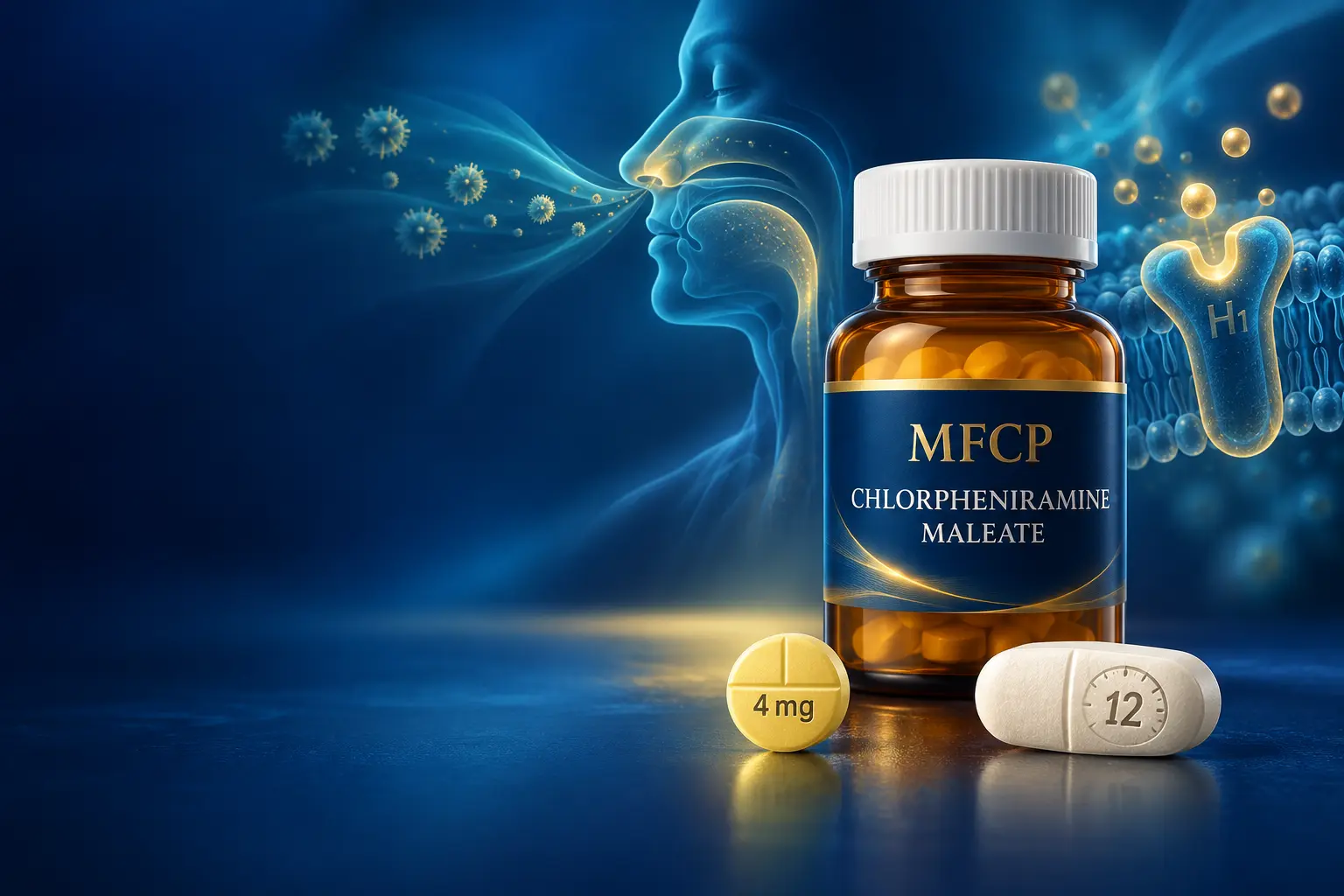
First-generation oral antihistamine · Controlled monograph
Chlorpheniramine Maleate 4 MG IMMEDIATE RELEASE · 12 MG EXTENDED RELEASE
Short-term allergy relief with drowsiness, drying-effect, and release-form controls.
 01
Contents
02At-a-Glance and Bottom Line
Chlorpheniramine Maleate
Monograph at a Glance · allergy relief · two release forms · alertness control
Older allergy medicine
Chlorpheniramine maleate is a first-generation alkylamine antihistamine. It relieves sneezing, runny nose, itchy or watery eyes, and itching of the nose or throat.
The central tradeoff
It works, is inexpensive, and causes moderate drowsiness and drying. For routine daytime allergy, a newer less-sedating antihistamine is usually a better choice.
Use it for short-term relief when sleepiness and drying will not create a safety problem. Never drive until you know your response.
 03
Who It Suits
May fit
- Short-term allergy or cold symptoms
- Night-time sneezing or runny nose
- A person who can avoid driving and alcohol
Choose another path
- Daily daytime allergy control
- Age 65 or older
- Glaucoma, urinary retention, or significant breathing disease without clinician review
 04
Package Identity
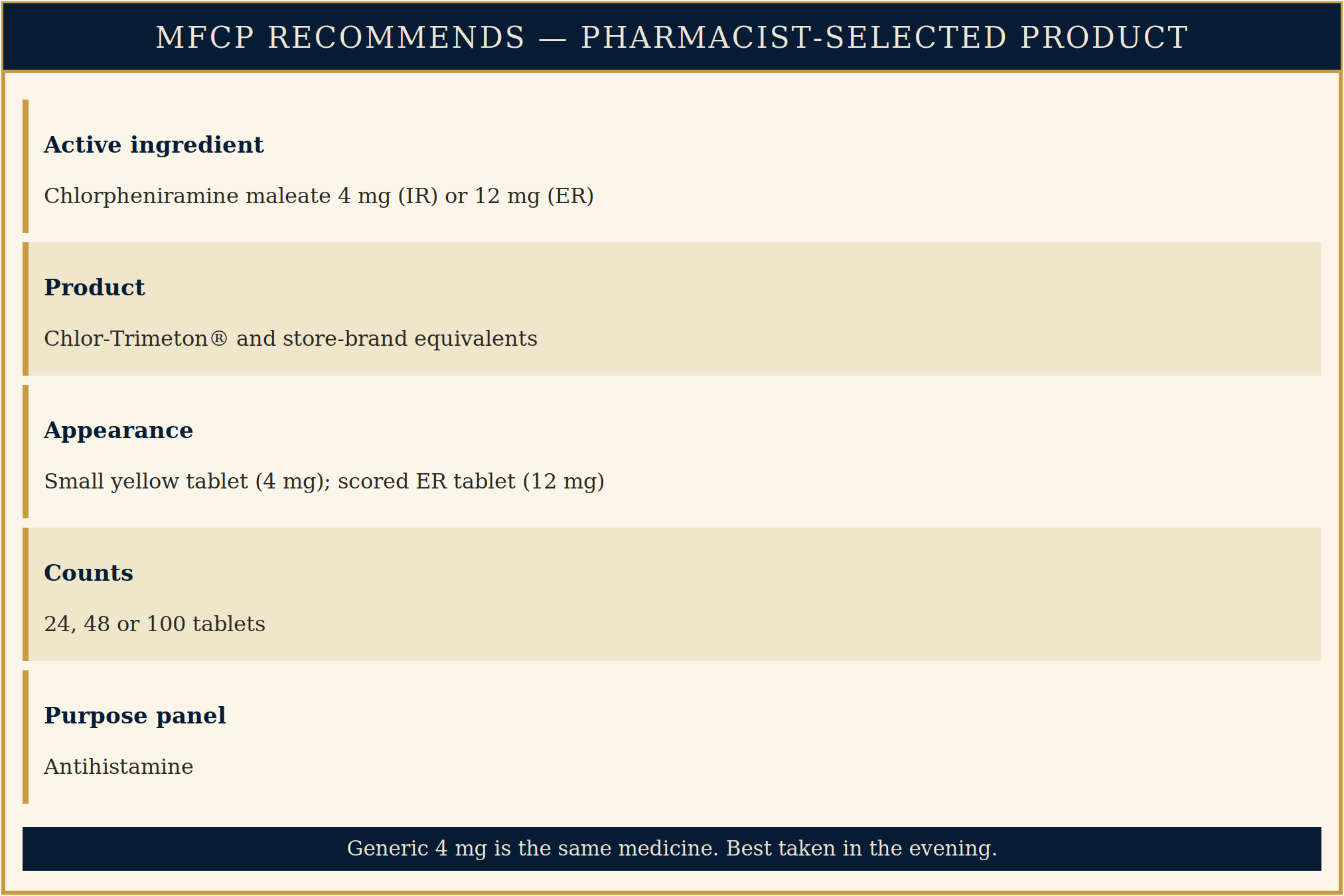
Active ingredient
Chlorpheniramine maleate 4 mg immediate release or 12 mg extended release.
Purpose
First-generation H1 antihistamine for temporary allergy symptom relief.
Appearance
Immediate-release tablets and liquids exist. Extended-release products must be clearly labeled 12-hour.
 05
How to Use It
| Formulation | Age | Dose | Daily maximum |
|---|---|---|---|
| Immediate release | 12 years and older | 4 mg every 4–6 hours as needed | 24 mg |
| Immediate release | 6–11 years | 2 mg every 4–6 hours as needed | 12 mg |
| Immediate release | 4–5 years | 1 mg every 4–6 hours as needed | 4 mg |
| Extended release | 12 years and older | 12 mg every 12 hours | 24 mg |
Do not crush, chew, or split an extended-release tablet. Follow the exact Drug Facts label for the selected product.
 06
Children and Formulations
Immediate release
Tablet or liquid. Onset is generally 30–60 minutes and relief lasts about 4–8 hours.
Extended release
A 12 mg, 12-hour form is for people age 12 and older. Under age 12: do not use the extended-release form.
The adult half-life is about 14–25 hours, so drowsiness and drying may persist after symptom relief fades.
 07
Do Not Stack Depressants
| Do not combine with | Why | Action |
|---|---|---|
| Alcohol | Additive central nervous system depression | Avoid |
| Sedatives, hypnotics, opioids, or tranquilizers | More drowsiness and impaired reaction time | Ask first; usually avoid |
| Another antihistamine or PM product | Duplicate drug and drying effects | Check every active ingredient |
 08
Who Must Not Use It
- Do not use for children below the age allowed by the exact formulation label.
- Avoid or obtain clinician approval with narrow-angle glaucoma, prostatic enlargement, or urinary retention.
- Use great care with stenosing peptic ulcer or pyloroduodenal obstruction.
- Ask first with asthma or COPD because secretions may thicken.
- Adults age 65 and older should generally avoid first-generation antihistamines.
 09
When to Seek Care
Urgent care
- Difficulty breathing or facial swelling
- Confusion, collapse, seizure, or inability to wake
- Inability to pass urine or a dangerous heartbeat symptom
Contact a clinician
- Symptoms worsen or last more than 7 days
- High fever or severe facial pressure or pain
- Persistent daytime impairment
 10
The Molecule
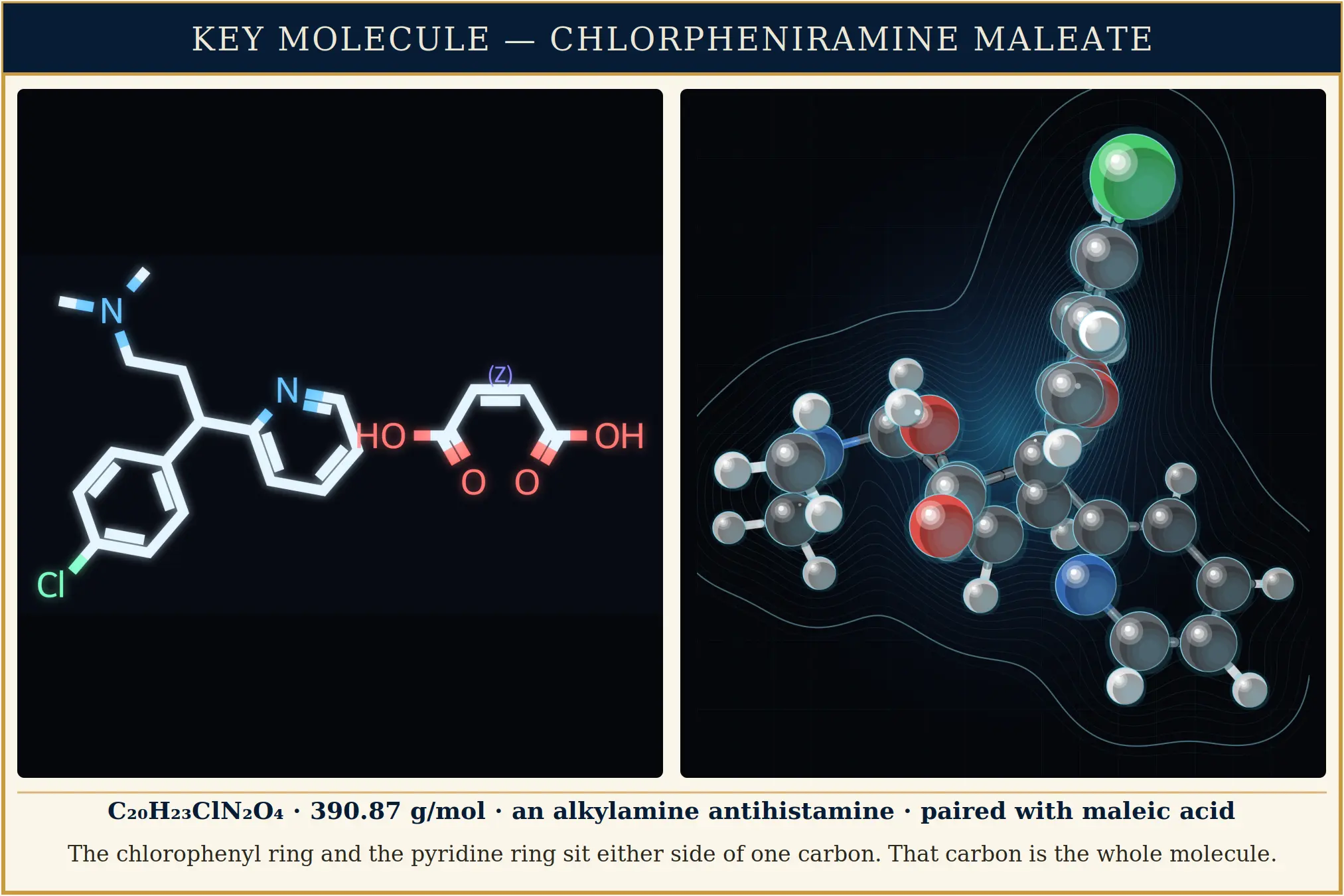
| Formula | C20H23ClN2O4 |
|---|---|
| Molar mass | 390.87 g/mol |
| Class | First-generation alkylamine H1-receptor antagonist |
| Clinical meaning | It acts in the body and crosses into the brain. |
 11
How It Works
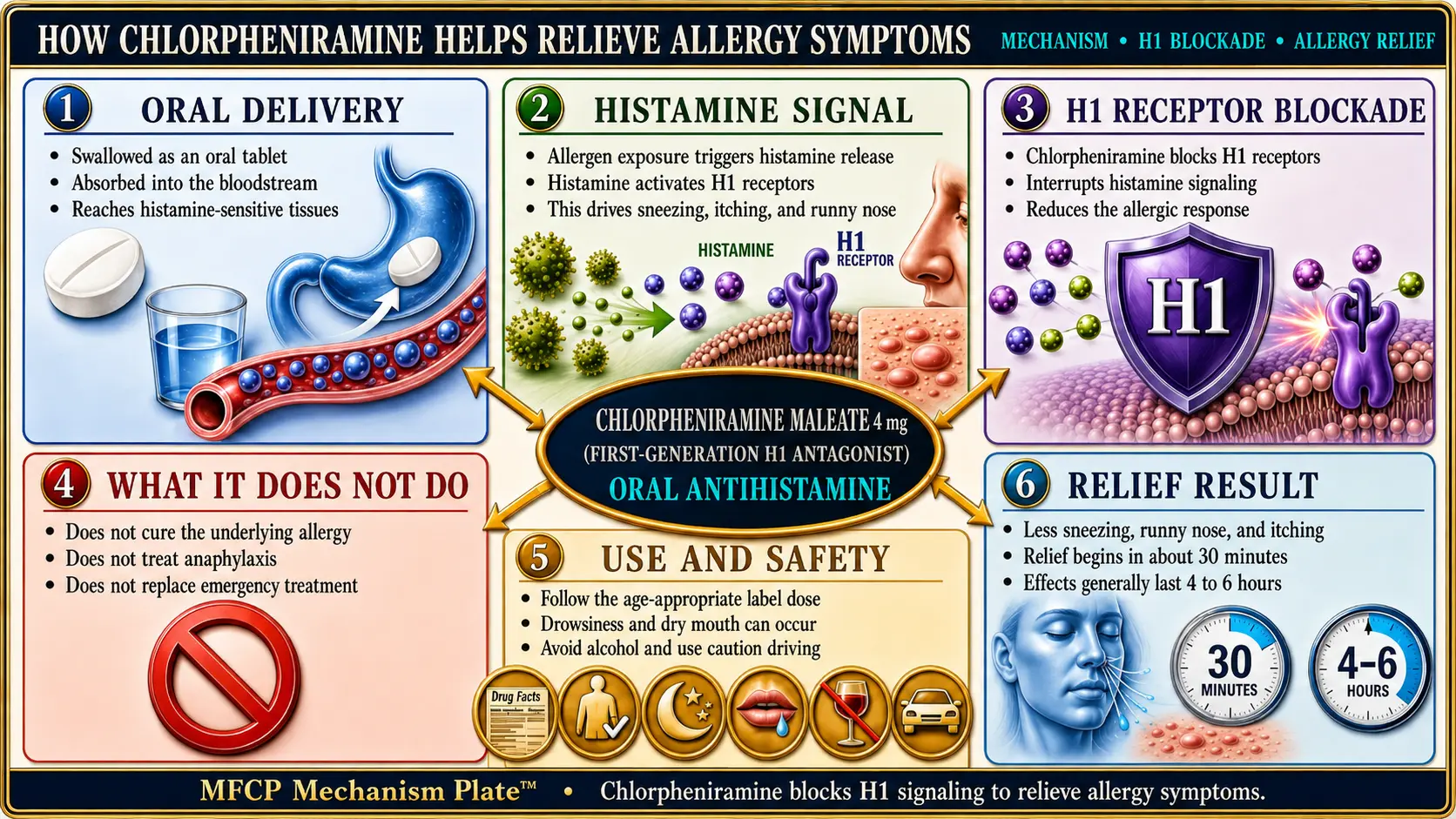
H1 blockade
Competitive, reversible receptor blockade reduces histamine-driven symptoms.
Brain entry
Central H1 blockade produces moderate sedation and slower reactions.
Muscarinic blockade
The drying action can reduce nasal drip but also cause dry mouth, blurred vision, constipation, and urinary difficulty.
 12
Sedation and Impairment
Moderate is not mild. Avoid driving, machinery, and any task requiring mental alertness until the individual response is known.
Drowsiness is part of the drug's action, not a rare defect. Evening use may make this tradeoff easier to manage, but it does not remove impairment risk.
 13
Older Adults and the Beers Criteria
First-generation antihistamines, including chlorpheniramine, are potentially inappropriate for many older adults. Confusion, dry mouth, constipation, urinary retention, sedation, orthostatic imbalance, and falls are key concerns.
 14
What the Evidence Shows
| Question | Evidence-controlled answer |
|---|---|
| Does it relieve labeled allergy symptoms? | Yes, for short-term symptom relief. |
| Does it cure the allergy? | No. |
| Does it treat anaphylaxis? | No. It does not replace emergency treatment. |
| How fast? | Relief may begin in about 30–60 minutes. |
| How long? | About 4–8 hours for immediate release; up to 12 hours for extended release. |
 15
Against Other Antihistamines
| Medicine | Sedation | Best fit |
|---|---|---|
| Chlorpheniramine | Moderate | Short-term, often evening use |
| Diphenhydramine | Marked | Selected short-term uses; not routine daily allergy |
| Loratadine | Low | Daily daytime allergy |
| Cetirizine / levocetirizine | May occur | Daily allergy when faster onset is useful |
| Fexofenadine | Least sedating | Work or driving days; avoid fruit juice around the dose |
 16
Counseling Algorithm
- Confirm the target symptom. Use one medicine only when its labeled purpose matches.
- Confirm the form and age. Immediate and extended release are not interchangeable.
- Screen the person. Driving, age 65+, glaucoma, urinary problems, breathing disease, alcohol, and sedatives change the decision.
- Set the limit. State the dose, maximum, stop point, and red flags.
 17
MFCP Buying Standard
Green flags
- Single active ingredient
- Strength and release type clearly stated
- Readable Drug Facts, lot, expiration, and seal
- Age and dose match the user
Red flags
- Unneeded multi-symptom combination
- Missing or unclear release type
- Duplicate antihistamine or PM product
- Use by an older adult without review
 18
Evidence and References
Evidence & Source Control
Immediate-release, extended-release, geriatric-safety, and lactation sources remain explicitly separated
- FDA OTC Monograph M012: cough, cold, allergy, bronchodilator, and antiasthmatic drug products.
- DailyMed: chlorpheniramine maleate 4 mg immediate-release tablet.
- DailyMed: Chlorphen-12 chlorpheniramine maleate 12 mg extended-release tablet.
- American Geriatrics Society 2023 Beers Criteria® Update.
- NIH Drugs and Lactation Database (LactMed): Chlorpheniramine.
- MFCP Chlorpheniramine Monograph Prototype, 28 July 2026.
- MFCP Chlorpheniramine visual and identifier controls, 19 August 2026.
19Health Literacy and Readability