
CaCO3 · 100.09 g/mol (National Center for Biotechnology Information, n.d.)
Michael’s Formulary & Clinical Perspective™ (MFCP)America’s OTC Pharmacy™ · Professional Judgment. Delivered.™
MFCP Monograph · Domain 02 · Digestive Health
Calcium Carbonate
Antacid · Chewable tablets, 500 mg to 1,000 mg
A chewable antacid that neutralizes stomach acid already present (Maton & Burton, 1999). It treats occasional heartburn, acid indigestion and sour stomach (Haleon, n.d.-a).

Use
Occasional heartburn
Form
Chew completely
Label age
12 years and older
Self-care limit
2 weeks
Pharmacist bottom line
Fast relief for heartburn that comes and goes. Not a daily acid controller.
Chew the tablet completely before swallowing (Haleon, n.d.-a). Do not take it for symptoms that last more than 2 weeks unless a doctor advises it (Haleon, n.d.-a). Count the calcium from every product the person takes, not only this one (Office of Dietary Supplements, n.d.).
ScopeOver-the-counter (OTC) antacid use only. Prescription uses, such as phosphate binding in kidney disease, are outside this monograph.
MFCP MonographCalcium Carbonate1 / 9
01
Rapid acid neutralization

What it is and how it works
Calcium carbonate reacts with stomach acid and turns it into calcium chloride, water and carbon dioxide gas (Maton & Burton, 1999). It works on acid that is already there. It does not stop the stomach from making more (Maton & Burton, 1999).
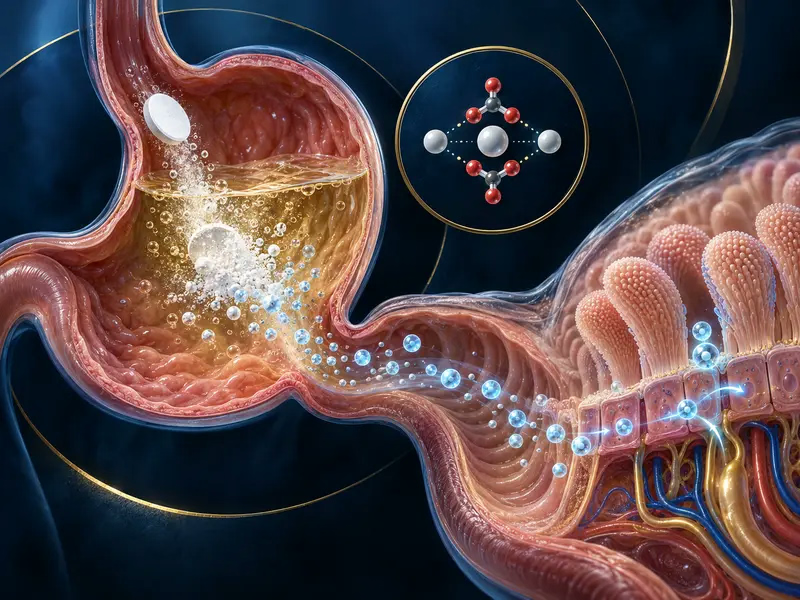
Formula
Class
Antacid (Haleon, n.d.-a)
Calcium by weight
40% elemental calcium (Office of Dietary Supplements, n.d.)
Forms
Chewables and soft chews
Three things happen in the stomach
Neutralize
Acid goes down
Acid is neutralized within minutes (Maton & Burton, 1999).
Gas
Carbon dioxide forms
Carbon dioxide can cause belching and fullness (Maton & Burton, 1999).
Rebound
Acid can come back
Extra acid can follow when the effect wears off (Maton & Burton, 1999).
LimitQuick neutralization does not explain the cause of repeated heartburn, reflux or chest symptoms.
MFCP MonographCalcium Carbonate2 / 9
02
Read the label in hand
Dose and limits
Each strength has its own daily maximum, and a lower one in pregnancy (Haleon, n.d.-a; Haleon, n.d.-b; Haleon, n.d.-c). Read the strength on the package before you give a count.
Product
Calcium carbonate
Calcium per tablet
Chew per dose
Max in 24 hours
Max if pregnant
Regular Strength 500
500 mg
200 mg*
2–4
15
10
Extra Strength 750
750 mg
300 mg
2–4
10
6
Ultra Strength 1000
1,000 mg
410 mg
2–3
7
5
Tums labels: Regular (Haleon, n.d.-c), Extra Strength (Haleon, n.d.-b), Ultra Strength (Haleon, n.d.-a). *Calculated as 40% of 500 mg (Office of Dietary Supplements, n.d.); the other calcium values are printed on the label. Store brands vary: read the label in hand.
Rules on every label
1
Adults and children 12 years and older: chew as symptoms occur, or as directed by a doctor (Haleon, n.d.-a). The label gives no dose under age 12, so a child under 12 needs a doctor’s advice (Haleon, n.d.-a).
2
Chew or crush the tablets completely before swallowing (Haleon, n.d.-a).
3
Do not take it for symptoms that last more than 2 weeks unless a doctor advises it (Haleon, n.d.-a).
4
Ask a doctor or pharmacist first if the person takes a prescription drug (Haleon, n.d.-a).
MFCP MonographCalcium Carbonate3 / 9
03
Count every source
Daily calcium ceiling and special populations
Calcium carbonate is a calcium source as well as an antacid (Office of Dietary Supplements, n.d.). Supplements, prenatal vitamins and antacids all add to one daily total.
Tablet mg × 0.40 = calcium mg
Calcium carbonate is 40% calcium by weight (Office of Dietary Supplements, n.d.). Seven Ultra Strength tablets at 410 mg each give 2,870 mg of calcium, before any other source (Haleon, n.d.-a).
Upper limit for calcium from all sources, per day
3,000 mg
Ages 14–18, including pregnancy
2,500 mg
Ages 19–50, including pregnancy
2,000 mg
Ages 51 and older
Tolerable upper intake levels for calcium from food and supplements combined (Office of Dietary Supplements, n.d.). Ages 19 to 50 have the same 2,500 mg limit while breastfeeding (Office of Dietary Supplements, n.d.).

Pregnancy
The label sets a lower daily maximum in pregnancy: 10, 6 or 5 tablets by strength (Haleon, n.d.-c; Haleon, n.d.-b; Haleon, n.d.-a).
The upper limit does not rise in pregnancy: 2,500 mg a day for ages 19 to 50 (Office of Dietary Supplements, n.d.). Count the prenatal vitamin.
Breastfeeding
The upper limit is 2,500 mg a day for ages 19 to 50 (Office of Dietary Supplements, n.d.).
The Tums labels give no separate breastfeeding limit (Haleon, n.d.-a). Follow the standard label count.
Older adults
The upper limit falls to 2,000 mg a day at age 51 (Office of Dietary Supplements, n.d.).
Calcium antacids can cause constipation (Maton & Burton, 1999). Ask about bowel habits and other calcium sources.
MFCP MonographCalcium Carbonate4 / 9
04
Expected effects and the serious one

Side effects and safety
Most effects are mild and come from the chemistry itself (Maton & Burton, 1999). The serious risk comes from taking too much calcium for too long (StatPearls Publishing, n.d.).
Gas and belching
Carbon dioxide from the reaction causes belching and fullness (Maton & Burton, 1999).
Acid rebound
Acid can return after the dose wears off (Maton & Burton, 1999). Frequent repeat dosing is a reason to reassess, not to take more.
Constipation
Calcium antacids can slow the bowel (Maton & Burton, 1999).
Medicine binding
Antacids may interact with certain prescription drugs (Haleon, n.d.-a). See Interactions on page 6.
!
Milk-alkali syndrome
High calcium, metabolic alkalosis and acute kidney injury together (StatPearls Publishing, n.d.). Today it occurs from taking inappropriately high amounts of calcium carbonate (StatPearls Publishing, n.d.). Confusion, nausea or new weakness in someone taking large amounts needs medical care.
Ask a doctor or pharmacist first
1
Takes a prescription drug (Haleon, n.d.-a).
2
Has kidney disease, for combination products with famotidine (“Pepcid Complete,” n.d.).
3
Already takes a calcium supplement or prenatal vitamin (Office of Dietary Supplements, n.d.).
MFCP MonographCalcium Carbonate5 / 9
05
Calcium binds other medicines
Interactions
Calcium can bind some oral medicines in the gut and lower how much is absorbed (Office of Dietary Supplements, n.d.; Maton & Burton, 1999). Spacing the doses prevents it.
Medicine
What happens
Spacing
Levothyroxine
Calcium carbonate can lower levothyroxine absorption (Office of Dietary Supplements, n.d.).
Keep at least 4 hours apart (Office of Dietary Supplements, n.d.).
Quinolone antibiotics
Calcium can lower absorption of quinolone antibiotics (Office of Dietary Supplements, n.d.).
Antibiotic 2 hours before or 2 hours after calcium (Office of Dietary Supplements, n.d.). Use the antibiotic’s label if it says longer.
Tetracyclines
Antacids reduce tetracycline absorption (Maton & Burton, 1999).
Follow the antibiotic’s label spacing.
Iron
Antacids reduce iron absorption (Maton & Burton, 1999).
Follow the iron product’s label spacing.
Rule
When two labels give different spacing, use the longer one.
LabelAntacids may interact with certain prescription drugs. Ask a doctor or pharmacist before use if taking one (Haleon, n.d.-a).
MFCP MonographCalcium Carbonate6 / 9
06
Right product, right job

Choose, buy and verify
Three heartburn products do three different jobs. Match the job to the pattern of symptoms.
Calcium carbonate
Famotidine
Omeprazole
Job
Neutralizes acid already present
Lowers acid the stomach makes
Blocks the final acid pump
Best fit
Occasional heartburn, now
Heartburn expected after a trigger
Frequent heartburn, two or more days a week
Not for
Daily, ongoing control
Rescue in minutes
Rescue in minutes
Comparison by mechanism and job, consistent with the MFCP Gastrointestinal OTC Clinical Pathways (MFCP analysis). Each product’s own label controls its use.
!
Pepcid Complete is not a stronger Tums
It adds famotidine 10 mg and magnesium hydroxide 165 mg to calcium carbonate 800 mg (“Pepcid Complete,” n.d.). Chew 1 tablet, no more than 2 in 24 hours, for no more than 14 days without a doctor (“Pepcid Complete,” n.d.). Do not use it with other acid reducers (“Pepcid Complete,” n.d.).
MFCP Buying Standard™ · check the package in hand
1
Active ingredientCalcium carbonate, with the mg per tablet (Haleon, n.d.-a).
2
PurposeAntacid (Haleon, n.d.-a).
3
DirectionsAge, tablets per dose, daily maximum and pregnancy maximum (Haleon, n.d.-a).
4
Other informationElemental calcium per tablet, to add to the daily total (Haleon, n.d.-a).
MFCP MonographCalcium Carbonate7 / 9
07
Clinical red-line gate
When to stop and get care
Antacid relief should never delay care for bleeding, swallowing trouble or a possible heart problem.
Get care now
1
Trouble or pain swallowing food (“Pepcid Complete,” n.d.)
2
Vomiting with blood, or bloody or black stools (“Pepcid Complete,” n.d.)
3
Heartburn with lightheadedness, sweating or dizziness (“Pepcid Complete,” n.d.)
4
Chest pressure or pain that spreads to the arm, neck or jaw: call 911 (MFCP analysis)
5
Unexplained weight loss, frequent chest pain, or nausea or vomiting (“Pepcid Complete,” n.d.)
Stop and ask a doctor
1
Symptoms last more than 2 weeks (Haleon, n.d.-a).
2
The maximum dose has been needed for more than 2 weeks (Haleon, n.d.-a).
3
Heartburn continues or gets worse (“Pepcid Complete,” n.d.).
MFCP bottom line
Name the symptom, confirm calcium carbonate is the active ingredient, keep to the label count for the strength in hand, count all calcium, space other medicines, and refer anything that lasts past 2 weeks.
MFCP MonographCalcium Carbonate8 / 9