
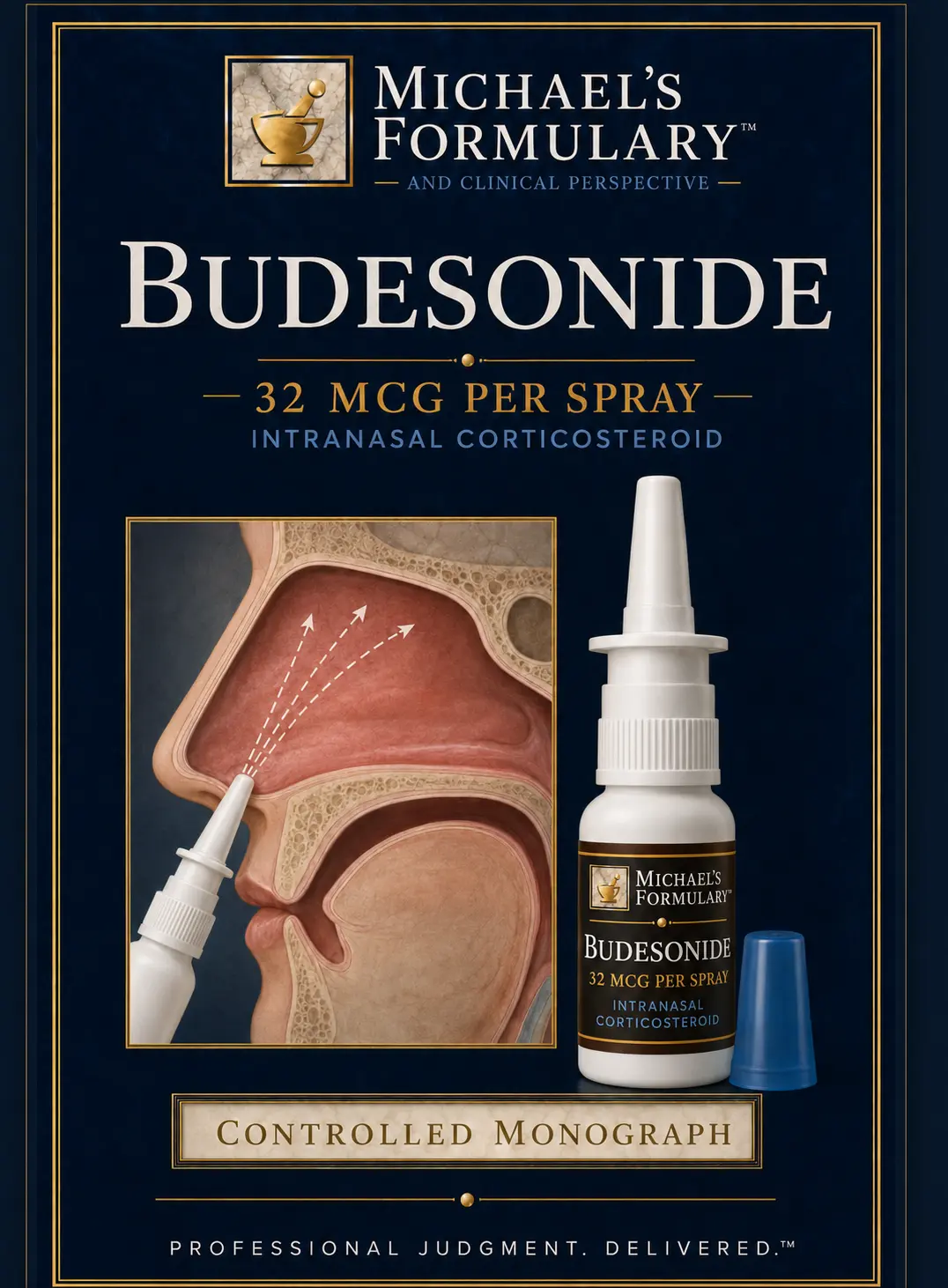

Intranasal corticosteroid · Controlled monograph
Budesonide 32 MCG PER SPRAY · RHINOCORT ALLERGY
Scent-free, once-daily anti-inflammatory control for nasal allergy symptoms.
The spray settles where allergy inflammation begins.
Budesonide reduces inflammatory gene signaling.
A tissue depot supports control across the day.
Part of the guide: Top 20 OTC Medicines for Ear and Balance Self-Care →
 02
Contents
Daily nasal allergy control. Correct aim. Consistent use.
Budesonide 32 mcg per spray reduces inflammation from seasonal and year-round allergies. It treats congestion, runny nose, nasal itching, and sneezing. It is not an instant decongestant; some symptoms may improve on the first day, but the most relief can take up to two weeks.

Best fit
Seasonal or year-round nasal allergy symptoms.
Key skill
Use the opposite hand and aim outward, away from the septum.

Hard stop
Under age 6: do not use for OTC self-care.
 03
MAG™ · Monograph at a Glance™

Budesonide
32 mcg per spray · intranasal corticosteroid


Budesonide
32 mcg per sprayRhinocort Allergy and properly matched store-brand equivalents.
Product control
Scent-free aqueous suspensionMatch the active ingredient, strength, route, age statement, and current Drug Facts label.
IDENTITY CONTROL: Budesonide is a different medicine from fluticasone. Do not substitute by drug-class name alone.
Where It Fits
04Therapeutic Domain Indicator™
Budesonide
Primary and secondary clinical placement
DOMAIN ASSIGNMENT: Eye, ear, nose, and throat is primary; respiratory, allergy, and sinus relief is secondary. No tertiary domain is assigned.
05Drug Identity and Chemistry
Generic name
Budesonide.
Brand example
Rhinocort Allergy; store-brand equivalents may be available.
Class
Intranasal glucocorticoid.
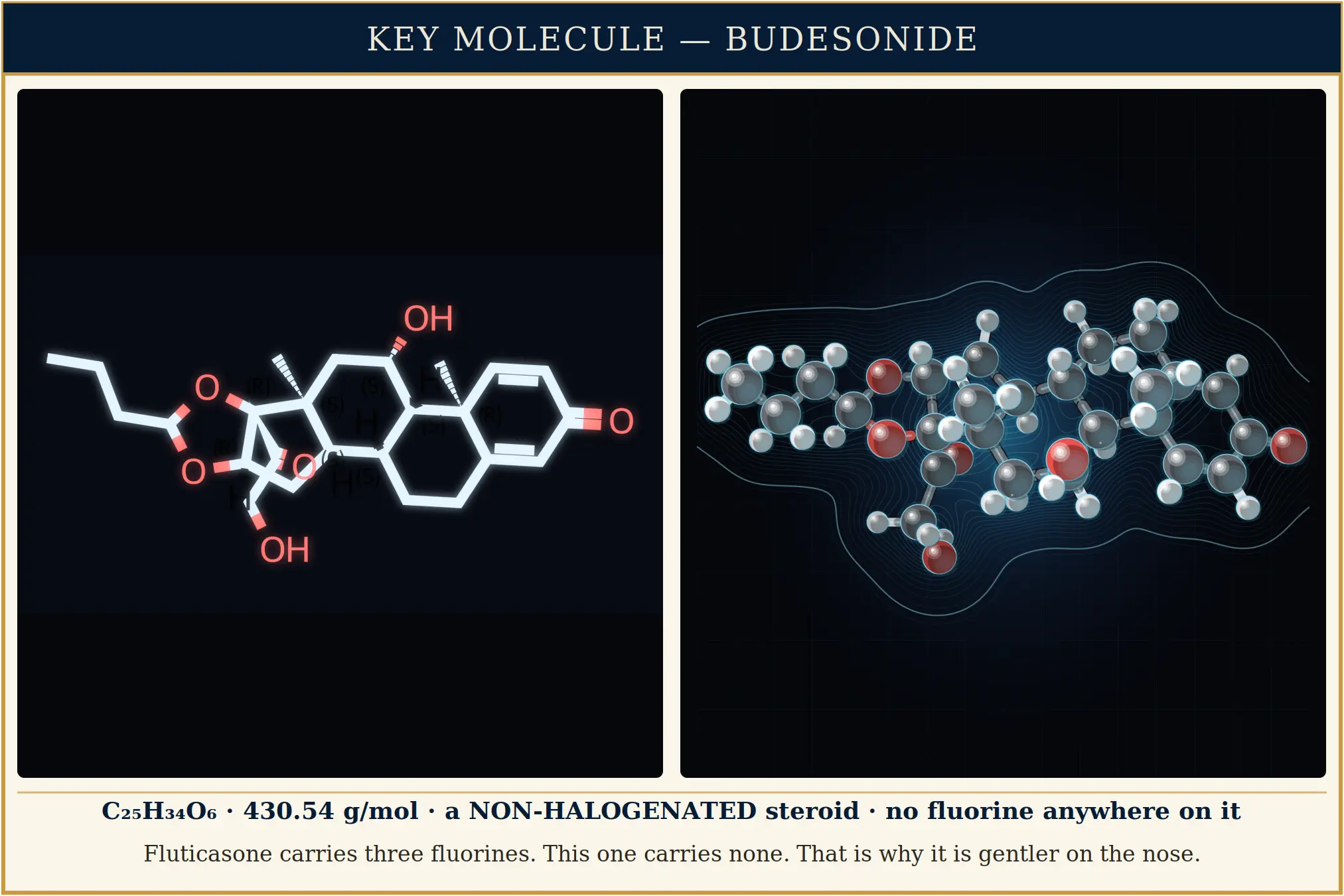
Formula
C₂₅H₃₄O₆.
Molecular mass
About 430.54 g/mol.
Form
Metered aqueous nasal spray, 32 mcg per spray.
 06
How It Holds Its Effect
The aqueous spray settles on the nasal lining, where budesonide enters nearby cells.
Inside the cell, budesonide binds its receptor and changes inflammatory gene signaling.
Histamine, leukotriene, and other allergy-related signals are reduced at their source.
Reversible fatty-acid conjugation forms a tissue depot that can extend local retention.
Free budesonide becomes available again across the day, supporting once-daily control.
Local delivery → inflammation control → sustained glucocorticoid-receptor action
Use It Right
07Who It Helps—and Who It Does Not
Use for allergic rhinitis
- Stuffy or blocked nose
- Runny nose
- Sneezing
- Nasal itching
Do not use as a substitute
- Not immediate rescue
- Not an antibiotic
- Not treatment for a cold
- Not a rebound-producing topical decongestant
 08
Dose by Age
| Who | Starting dose | Step-down and limit |
|---|---|---|
| Adults and ages 12+ | 2 sprays in each nostril once daily (128 mcg/day). | When controlled, step down to 1 spray in each nostril once daily (64 mcg/day). Maximum 128 mcg/day. |
| Children 6–11 | 1 spray in each nostril once daily (64 mcg/day). | If needed, the current label permits 2 sprays in each nostril once daily; step down when controlled. Talk to the child’s doctor if use is needed for longer than 2 months per year. |
| Under age 6 | Do not use for OTC self-care. | Refer to a pediatric clinician. |
 09
How to Use the Spray
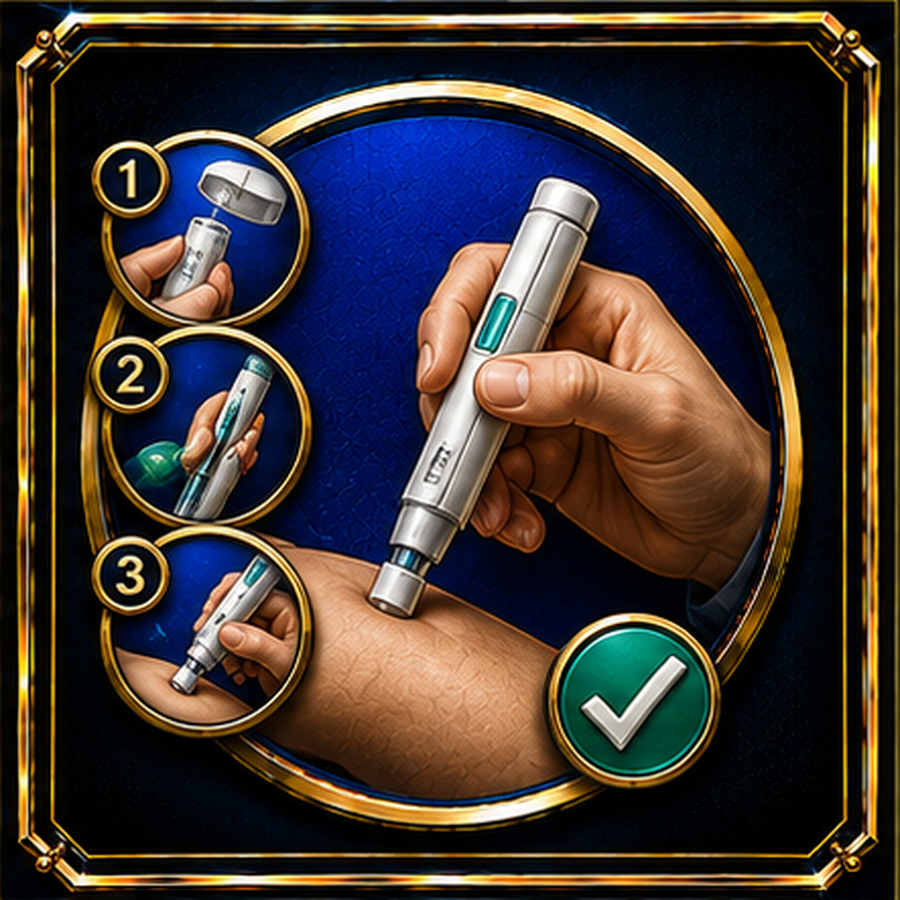
- PrepareGently blow your nose.
- PrimeShake the bottle and prime it exactly as the package directs. Prime again after two unused days.
- PositionKeep your head upright or slightly forward—not tilted back.
- Cross-handUse your right hand for the left nostril and your left hand for the right nostril.
- Aim outwardPoint the nozzle away from the center wall of your nose.
- Gentle inhalePress while breathing in gently. Do not sniff hard.
- FinishBreathe out through your mouth. Repeat only as directed.
- CleanWipe the nozzle, replace the cap, and do not share the bottle.
10Timing and Expectations
First effect
Some symptoms may improve on the first day.
Consistency
Use it every day during the allergy period.
Most relief
Daily use for up to two weeks may be needed.
Reassess
If symptoms have not improved, stop and ask a doctor.
Stay Safe
 11
Local Safety
Nosebleed
Severe or frequent bleeding requires stopping and asking a doctor.
Infection exposure
Stop and ask a doctor after exposure to chickenpox, measles, or tuberculosis.
Vision change
Any vision change needs prompt clinical assessment.
 12
Drug and Substance Interactions
Strong CYP3A4 inhibitors
Ritonavir, cobicistat, ketoconazole, itraconazole, and clarithromycin can raise steroid exposure.
Other steroids
Count inhaled, topical, oral, injected, and nasal steroids when assessing total exposure.
 13
Children, Pregnancy, and Older Adults
Children
Use the lowest effective dose. Monitor growth during prolonged use.
Pregnancy or breastfeeding
Ask a health professional before use. Weigh symptom control against medication exposure for the individual patient.
Older adults
Not a Beers medication. It avoids the sedation and drying burden of first-generation oral antihistamines.
Buy the Right Bottle
 14
MFCP Buying Standard™ · Product Identifier™
Rhinocort® Allergy Spray 32 mcg
- Active ingredient
- Budesonide
- Strength
- 32 mcg per spray
- Dosage form
- Metered intranasal aqueous suspension
- Product
- Rhinocort Allergy or a properly matched store-brand equivalent
Confirm budesonide 32 mcg per spray on the Drug Facts panel.
Scent-free and alcohol-free
- Formulation
- Scent-free, alcohol-free aqueous suspension
- Clinical reason
- An option when fragrance or alcohol led a patient to abandon another spray
- Appearance
- White aqueous suspension in a metered nasal pump
- Do not assume
- Package color alone does not establish product equivalence
Match the formulation and complete Drug Facts label—not the package color.
01 · Generic name
Verify Budesonide.
02 · Strength and route
Verify 32 mcg per spray for intranasal use.
03 · Package control
Confirm the seal, spray count, expiration, and current Drug Facts.
 15
Clinical Comparison
| Product | Identity | Control point |
|---|---|---|
| Budesonide | 32 mcg per spray; non-halogenated; scent- and alcohol-free. | Once-daily preventive control with a local tissue depot. |
| Fluticasone propionate | A different intranasal corticosteroid molecule. | Do not substitute by drug-class name alone. |
| Triamcinolone | A separate intranasal corticosteroid. | Check exact age and product labeling. |
| Oxymetazoline | Topical decongestant, not a steroid. | Fast relief; do not use longer than 3 days. |
Ask and Verify
 16
Counseling Pearls and Triage
| Finding | Action |
|---|---|
| No improvement after two weeks of correct daily use | Stop use and reassess diagnosis, adherence, and technique with a doctor. |
| Severe or frequent nosebleed | Stop and ask a doctor. |
| Exposure to chickenpox, measles, or tuberculosis | Stop and ask a doctor. |
| Persistent fever or another sign of infection | Stop and obtain clinical assessment. |
| Any vision change | Prompt clinical assessment. |
 17
Evidence and Source Control
- MFCP Deep Dive: Budesonide 32 mcg, July 25, 2026.
- MFCP Budesonide Monograph Prototype and FNID Prototype, July 28, 2026.
- MFCP Budesonide Monograph, August 19, 2026.
- ARIA 2020 rhinitis guidance and AAAAI/ACAAI 2020 rhinitis practice parameter.
- Current DailyMed budesonide 32 mcg OTC Drug Facts label.
Readability and literacy
 18
Health Literacy and Readability Control
HEALTH LITERACY & READABILITY CONTROL
BUDESONIDE MONOGRAPH
PATIENT-FIRST BY DESIGN
Short action lines, plain language, clear navigation, and visible safety rules support understanding.
EXACT MEASUREMENT SCOPE
397 running-body words from the patient-action text in Sections 6–13.
METHODS & CONTROLS
Flesch–Kincaid Grade Level was calculated from 397 words, 39 sentences, and 657 syllables, with editorial review.
READABILITY DISCLOSURE
MEETS NIH / MFCP TARGET
The measured patient-action text meets the Grade 8-or-lower target.
TECHNICAL CLINICAL / LEGAL LAYER
Brand labels, ingredient names, doses, tables, citations, and necessary terms remain visible for accuracy and are disclosed separately.