


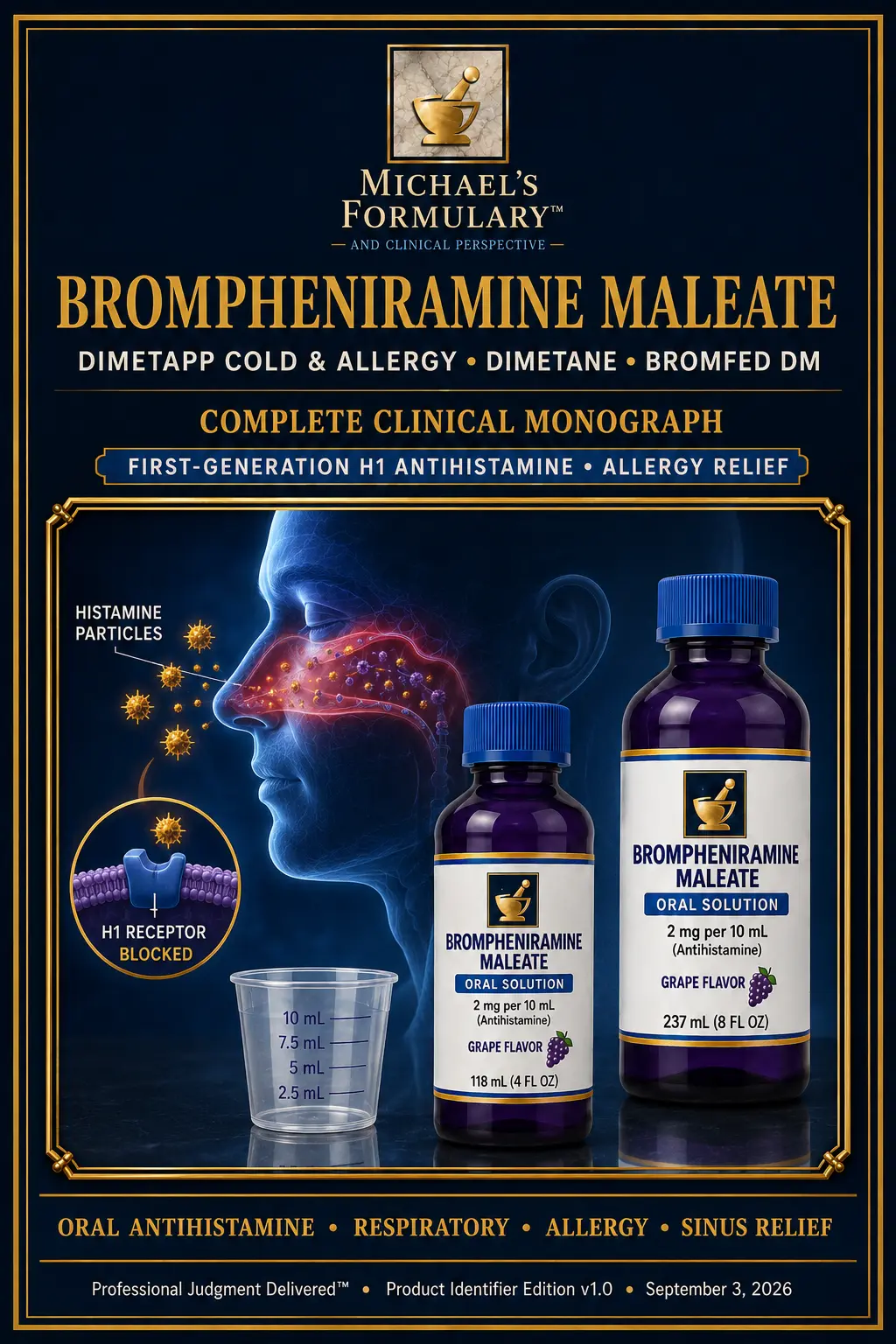
Brompheniramine Maleate
2 mg per 10 mL · Grape Oral Solution
Short-acting allergy relief with an important drowsiness and drying tradeoff.
 02
At-a-Glance and Bottom Line
Brompheniramine Maleate
Monograph at a Glance · allergy relief · four-hour interval · alertness control
First-generation antihistamine
Brompheniramine blocks H1 histamine receptors. It can relieve sneezing, runny nose, itchy or watery eyes, and itching of the nose or throat.
Main tradeoff
Drowsiness, slowed reactions, and drying can occur. A less-sedating antihistamine is often a better daytime choice.
Match the exact product to the symptom. Brompheniramine appears in both single-ingredient and multi-ingredient liquids; the products are not interchangeable.
 03
Who It Is For
May fit
- Temporary upper-respiratory allergy symptoms
- A person who can avoid driving and alcohol
- A child age 6 or older when the current OTC label permits use
Choose another path or ask first
- Routine daytime allergy control
- Age 65 or older
- Glaucoma, urinary difficulty, or chronic breathing disease
- Use with sedatives, tranquilizers, or another antihistamine
 04
Dose and Administration
| Current Dimetapp Cold & Allergy label | Dose | Limit |
|---|---|---|
| Adults and children 12 years and older | 20 mL every 4 hours | No more than 6 doses in 24 hours |
| Children 6 to under 12 years | 10 mL every 4 hours | No more than 6 doses in 24 hours |
| Children under 6 years | Do not use | Follow the current package label |
Use milliliters. Keep the dosing cup with the product. Different brompheniramine products may use different concentrations.
 05
What It Treats
- Runny nose
- Sneezing
- Itching of the nose or throat
- Itchy, watery eyes due to hay fever
Anaphylaxis, asthma attacks, bacterial infection, or the cause of an allergy.
 06
How It Works
Histamine signal
Histamine activates H1 receptors during an allergic response.
Competitive blockade
Brompheniramine occupies H1 receptors and reduces histamine-driven symptoms.
Brain and drying effects
Central H1 and anticholinergic activity can cause drowsiness, dry mouth, blurred vision, constipation, or urinary difficulty.
 07
Drowsiness and Drying
Drowsiness may occur. Alcohol, sedatives, and tranquilizers can increase it. Excitability may occur, especially in children.
 08
Warnings and Ask-First Screen
- Do not use to sedate a child or make a child sleepy.
- Ask a doctor first with glaucoma, trouble urinating from an enlarged prostate, emphysema, asthma, or chronic bronchitis.
- Do not take more than directed.
- Keep out of reach of children.
 09
Drug and Alcohol Interactions
| Check | Why | Action |
|---|---|---|
| Alcohol | More drowsiness and impairment | Avoid |
| Sedatives or tranquilizers | Additive central nervous system depression | Ask a doctor or pharmacist first |
| Another antihistamine or night product | Duplicate dosing and drying | Check all active ingredients |
| Oral decongestant or stimulant | The current Dimetapp label directs users to ask first | Review with a clinician or pharmacist |
 10
Children and Older Adults
Children
The current Dimetapp Cold & Allergy label is for ages 6 years and older. Never use it to make a child sleepy. Excitability can occur.
Older adults
First-generation antihistamines raise concern for confusion, dry mouth, constipation, urinary retention, and falls. A safer alternative is usually preferred.
 11
Pregnancy and Breastfeeding
If pregnant or breastfeeding, ask a health professional before use. Do not assume that a prescription combination has the same guidance as the OTC single-ingredient liquid.
 12
Overdose and Red Flags
Contact Poison Control at 1-800-222-1222 or seek emergency help. Severe sleepiness, agitation, hallucinations, seizures, breathing trouble, abnormal heart rhythm, or loss of consciousness require urgent care.
 13
Buying Standard
- Find brompheniramine maleate. Confirm the strength per mL.
- Count every active ingredient. Do not treat a combination as a single drug.
- Match the age and dose. Use the exact bottle label and supplied cup.
- Screen for drowsiness and drying. Driving, falls, glaucoma, urine flow, alcohol, and sedatives matter.
- Check the seal, lot, and expiration. Omit any product that cannot be verified.
 14
Use Checklist
 15
Clinical Comparison
| Medicine | Typical position | Key distinction |
|---|---|---|
| Brompheniramine | First generation | Short-acting; drowsiness and drying |
| Chlorpheniramine | First generation | Similar class; products and concentrations differ |
| Diphenhydramine | First generation | Often more sedating |
| Loratadine or fexofenadine | Second generation | Often preferred when alertness matters |
16Evidence and References
Evidence & Source Control
Current OTC labeling, federal monograph standards, prescription combinations, and older-adult safety remain explicitly separated
- DailyMed: Dimetapp Cold and Allergy — brompheniramine maleate solution.
- DailyMed: Bromfed DM prescription syrup.
- FDA OTC Monograph M012: Cold, Cough, Allergy, Bronchodilator, and Antiasthmatic Drug Products for OTC Human Use.
- American Geriatrics Society 2023 Updated AGS Beers Criteria®. Journal of the American Geriatrics Society. 2023;71(7):2052–2081.
17Health Literacy and Readability
Health Literacy & Readability
Plain Language
Short instructions emphasize what to do, what to avoid, and when to ask for help.
Measurement Scope
Patient-facing action text in Sections 2–15. Brand labels, dose tables, citations, and required clinical terms are retained for accuracy but excluded from the patient-action score.
Clinical Terms
Necessary terms are paired with practical meaning in context. A separate MFCP glossary will provide system-wide definitions.
Verification
Flesch–Kincaid estimates reading grade from sentence and word length. SMOG emphasizes words with three or more syllables. Method, editorial, and external checks are disclosed separately.
Clinical accuracy · plain language · clear navigation · actionable next steps