





Skip to content
MFCP mortar and pestle emblemMichael’s FormularyCLINICAL PERSPECTIVE™

Clinical library / Respiratory & allergy

On this page
01Introduction
INTRODUCTION

BUDESONIDE

32 mcg per spray · Budesonide

Intranasal corticosteroid · daily nasal allergy control

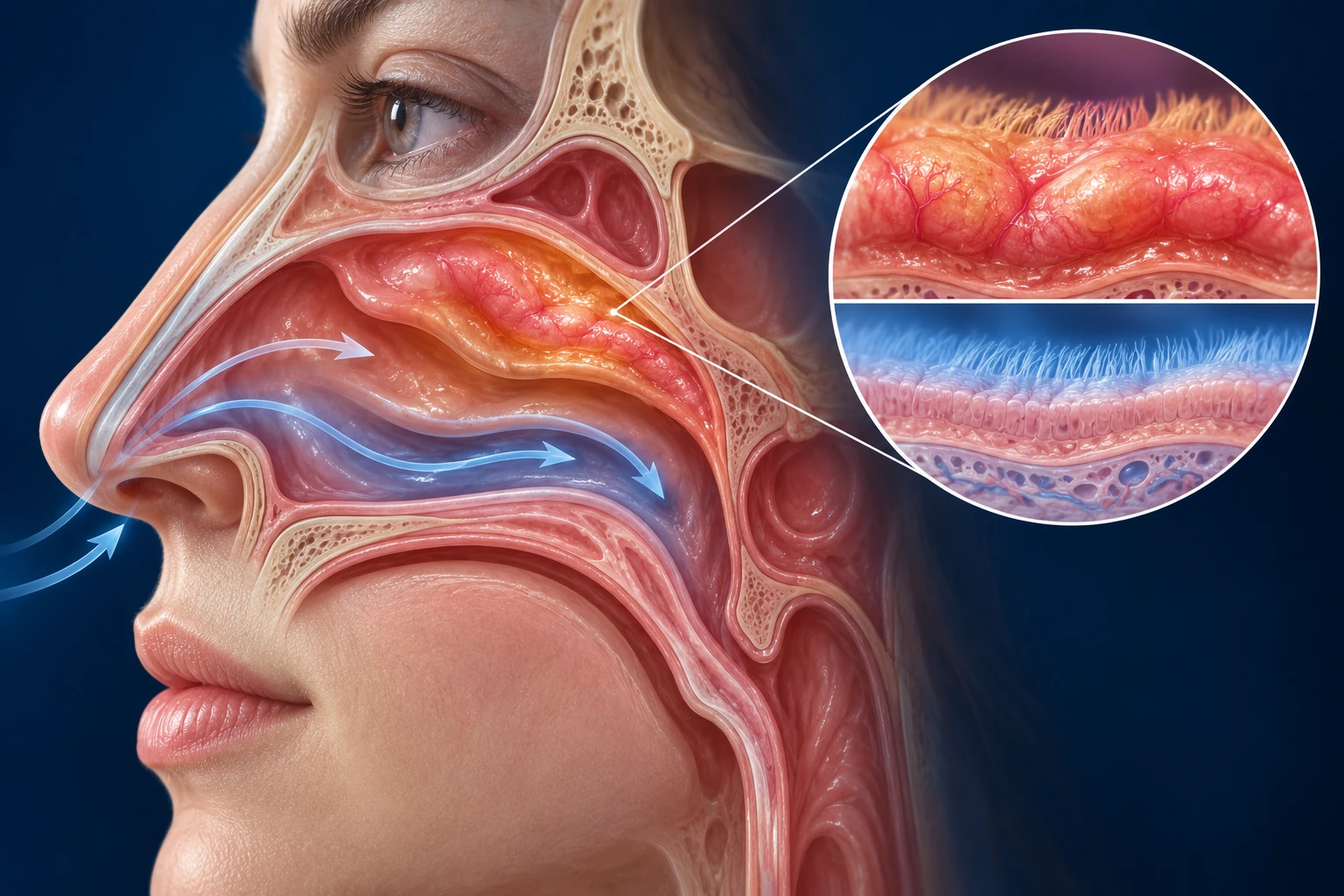
Woman beside a conceptual nasal cutaway; illustrative airflow, not measured relief
AMERICA’S OTC PHARMACY™

Clear guidance.
Comfortable care.

Know the medicine. Find the dose. Learn the spray technique.

Start with the Monograph at a Glance™MAG
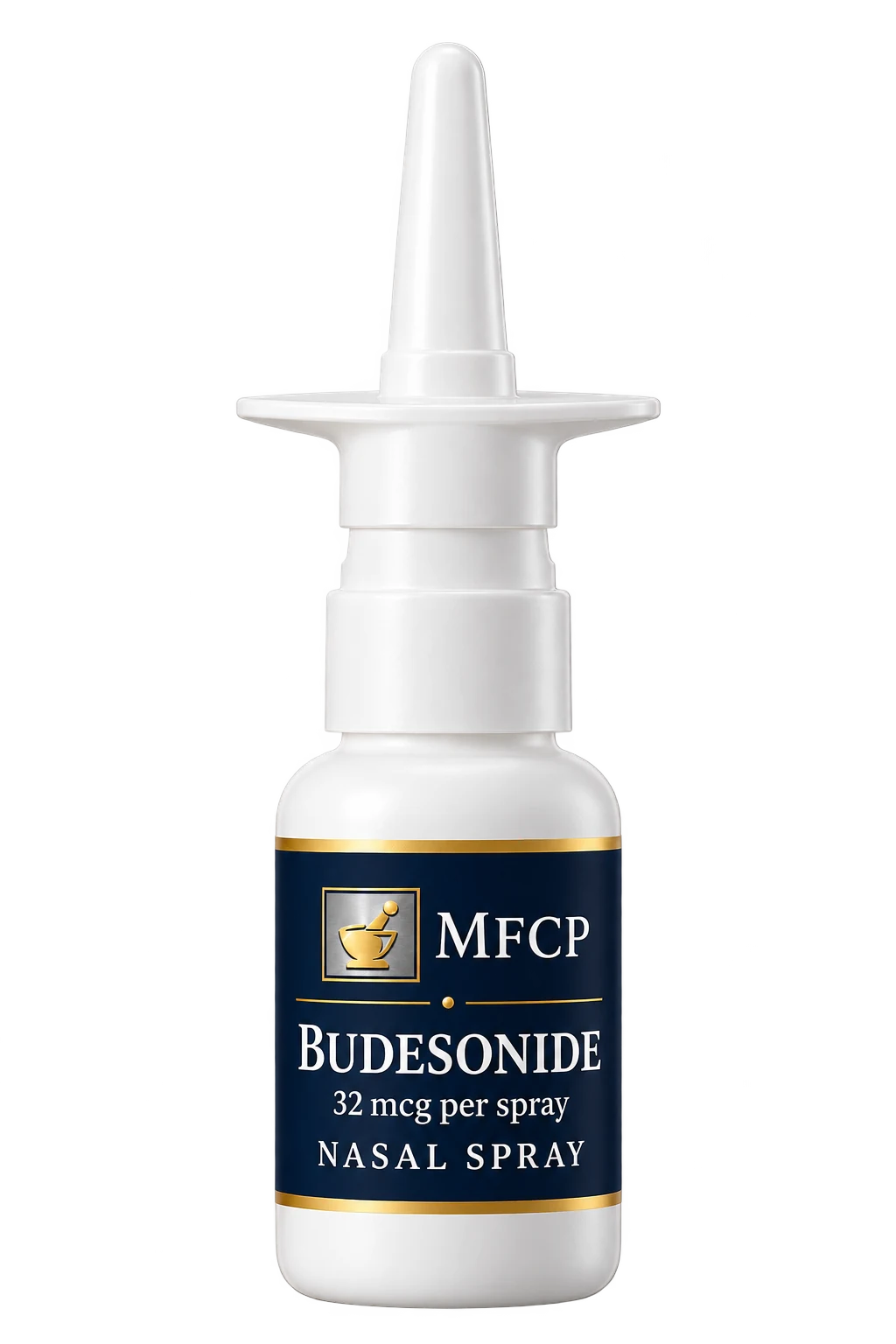
MFCP teaching illustration of a Budesonide nasal spray bottle labeled 32 mcg per spray; verify the actual package

Pharmacist Bottom Line

Use once daily as directed. Some symptoms may improve on the first day. Full relief may take up to two weeks of daily use.

If symptoms do not improve after two weeks, stop use and ask a doctor.

Do not use in children under age 6.

Anatomy and MFCP packaging are teaching illustrations. Verify the actual product’s Drug Facts.
02Contents
BUDESONIDE · 32 MCG PER SPRAY

Contents

Budesonide · 32 mcg per spray

03Monograph at a Glance™
BUDESONIDE · NASAL ALLERGY CONTROL

Monograph at a Glance™

Budesonide · 32 mcg per spray

Patient-friendly nasal allergy illustration

Budesonide

32 mcg per spray

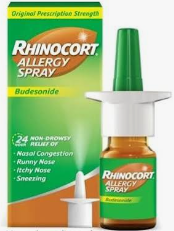
Rhinocort Allergy and properly matched store-brand equivalents.

MFCP teaching illustration of a Budesonide nasal spray bottle labeled 32 mcg per spray; verify the actual package
Active ingredientBudesonide
RouteInside the nose
OTC age6 years and older
RoleDaily allergy control

Product control

Scent-free aqueous suspension

Match the active ingredient, strength, route, age statement, and current Drug Facts label.

IDENTITY CONTROL: Budesonide is a different medicine from fluticasone. Do not substitute by drug-class name alone.

Anatomy and MFCP packaging are teaching illustrations. Verify the actual product’s Drug Facts.
Michael’s Formulary & Clinical Perspective™ · Professional Judgment Delivered™
04
MFCP READING STOP

Where It Fits

04Therapeutic Domain Indicator™
BUDESONIDE · NASAL ALLERGY CONTROL

Therapeutic Domain Indicator™

Budesonide · 32 mcg per spray

What this means

These categories help you find related information without expanding the product’s approved uses.

The spray goes inside the nose only. Do not spray into your eyes or mouth.

Other MFCP domains

Digestive · Nausea · DiarrheaNot assigned
Pain · Fever · InflammationNot assigned
Sleep · Stress · MoodNot assigned
Dermatology · Skin · HairNot assigned
Immunity · Vitamins · MineralsNot assigned
Women’s HealthNot assigned

DOMAIN ASSIGNMENT: Respiratory, allergy, and sinus relief is primary; eye, ear, nose, and throat is secondary. No tertiary domain is assigned.

Michael’s Formulary & Clinical Perspective™ · Professional Judgment Delivered™
05Drug Identity and Chemistry
BUDESONIDE · NASAL ALLERGY CONTROL

Drug Identity and Chemistry

Budesonide · 32 mcg per spray

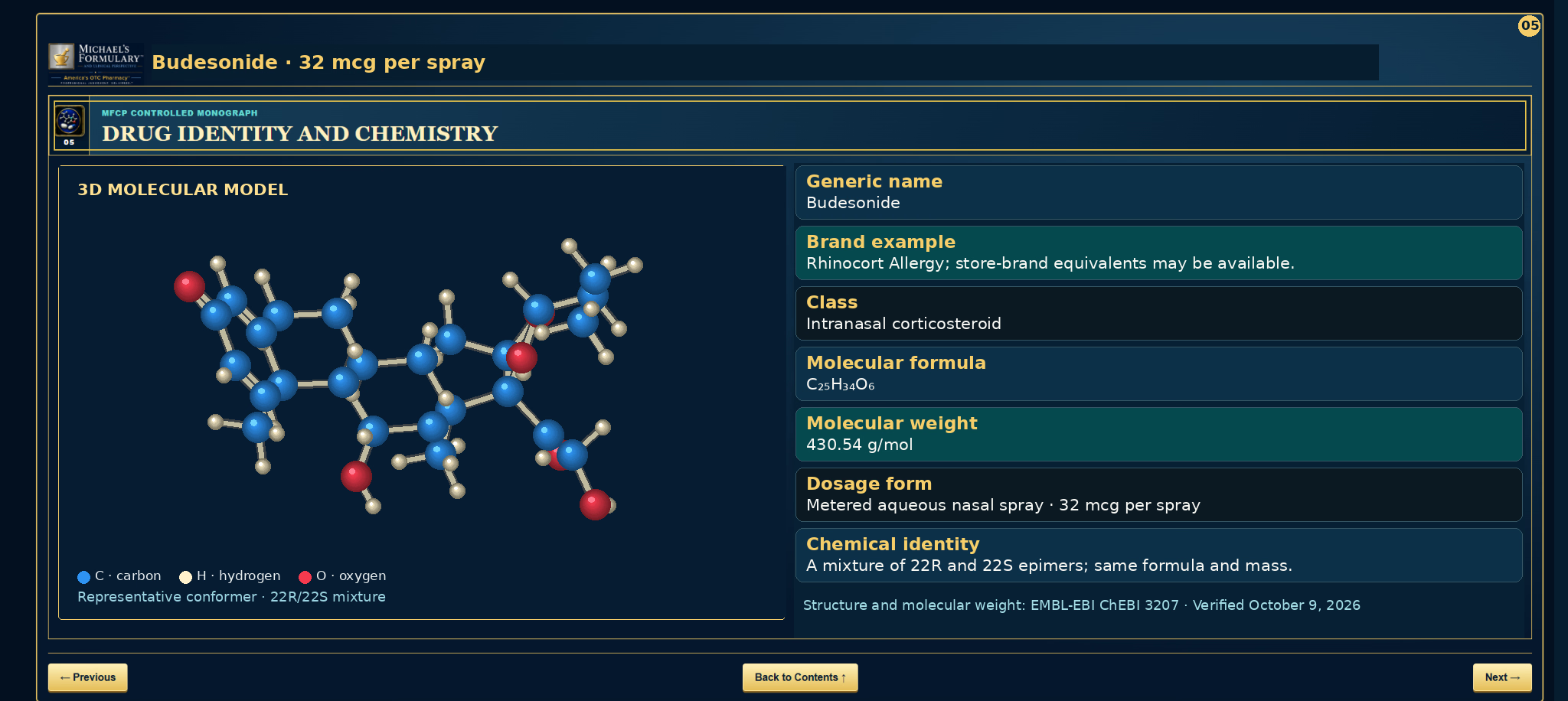
Budesonide — Drug Identity
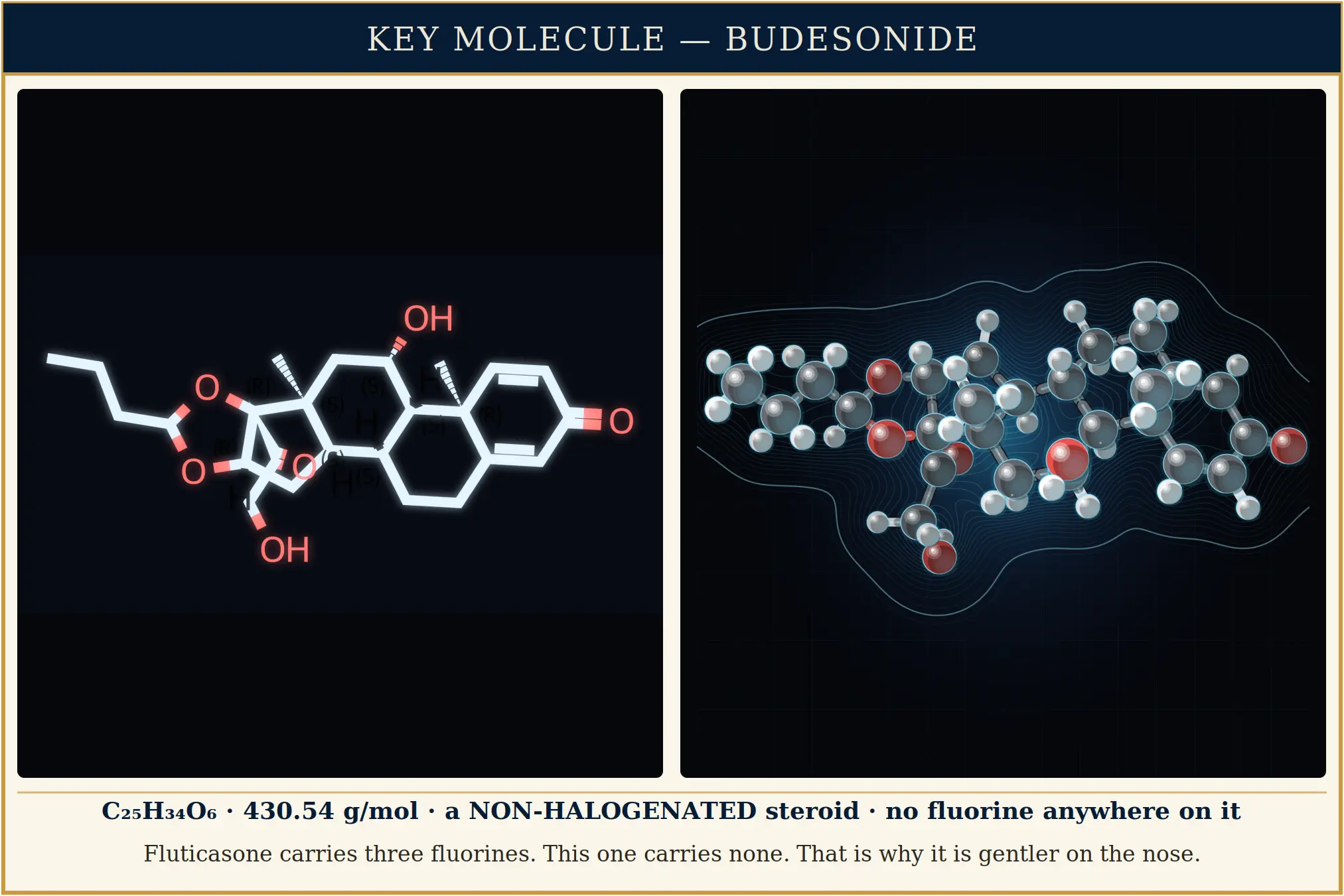
Illustrative three-dimensional Budesonide molecular model; native formula and mass are the identity reference

Generic name

Budesonide.

Brand example

Rhinocort Allergy; store-brand equivalents may be available.

Class

Intranasal glucocorticoid.

Formula

C₂₅H₃₄O₆.

Molecular mass

About 430.54 g/mol.

Form

Metered aqueous nasal spray, 32 mcg per spray.

Molecular imagery is illustrative. Formula and mass above are the native identity reference.

Michael’s Formulary & Clinical Perspective™ · Professional Judgment Delivered™
06How It Holds Its Effect
BUDESONIDE · NASAL ALLERGY CONTROL

How It Holds Its Effect

Budesonide · 32 mcg per spray

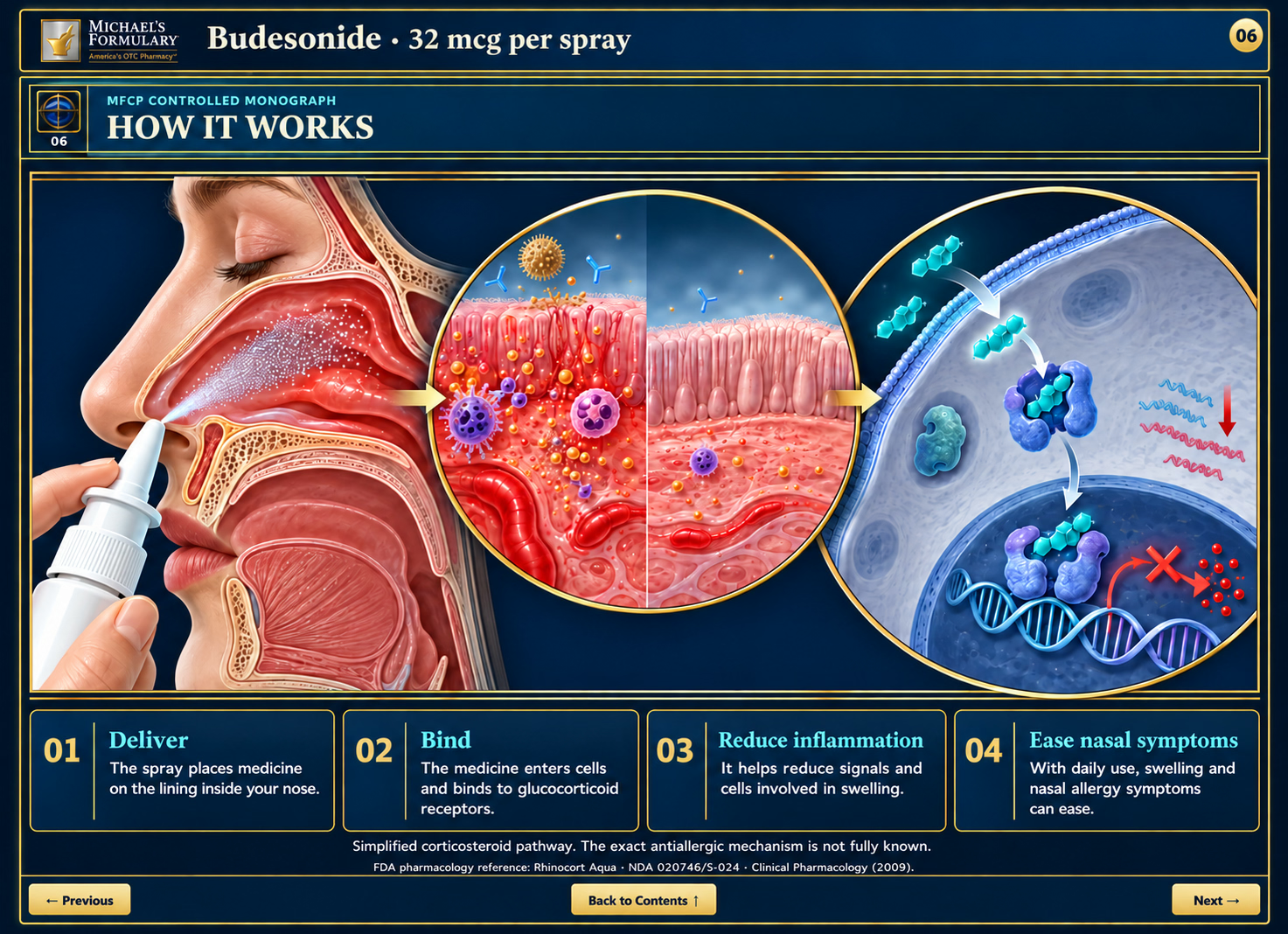
Budesonide — How It Works
Conceptual nasal delivery, enlarged mucosal response and intracellular steroid-receptor action; teaching imagery, not a measured outcome
01
It lands on the nasal lining

The aqueous spray settles on the nasal lining, where budesonide enters nearby cells.

02
It binds the glucocorticoid receptor

Inside the cell, budesonide binds its receptor and changes inflammatory gene signaling.

03
Inflammatory mediator release decreases

Histamine, leukotriene, and other allergy-related signals are reduced at their source.

04
Some budesonide enters local storage

Reversible fatty-acid conjugation forms a tissue depot that can extend local retention.

05
The depot releases active drug over time

Free budesonide becomes available again across the day, supporting once-daily control.

Local delivery → inflammation control → sustained glucocorticoid-receptor action

Mechanism background: Petersen et al., 2001. Local retention does not establish superiority or justify exceeding OTC doses.

Michael’s Formulary & Clinical Perspective™ · Professional Judgment Delivered™
05
MFCP READING STOP

Use It Right

07Who It Helps—and Who It Does Not
BUDESONIDE · NASAL ALLERGY CONTROL

Who It Helps—and Who It Does Not

Budesonide · 32 mcg per spray

Woman and conceptual nasal airflow

Use for allergic rhinitis

  • Stuffy or blocked nose
  • Runny nose
  • Sneezing
  • Nasal itching
Medicine safety warning

Do not use as a substitute

  • Not immediate rescue
  • Not an antibiotic
  • Not treatment for a cold
  • Not a rebound-producing topical decongestant
Michael’s Formulary & Clinical Perspective™ · Professional Judgment Delivered™
08Dose by Age
BUDESONIDE · NASAL ALLERGY CONTROL

Dose by Age

Budesonide · 32 mcg per spray

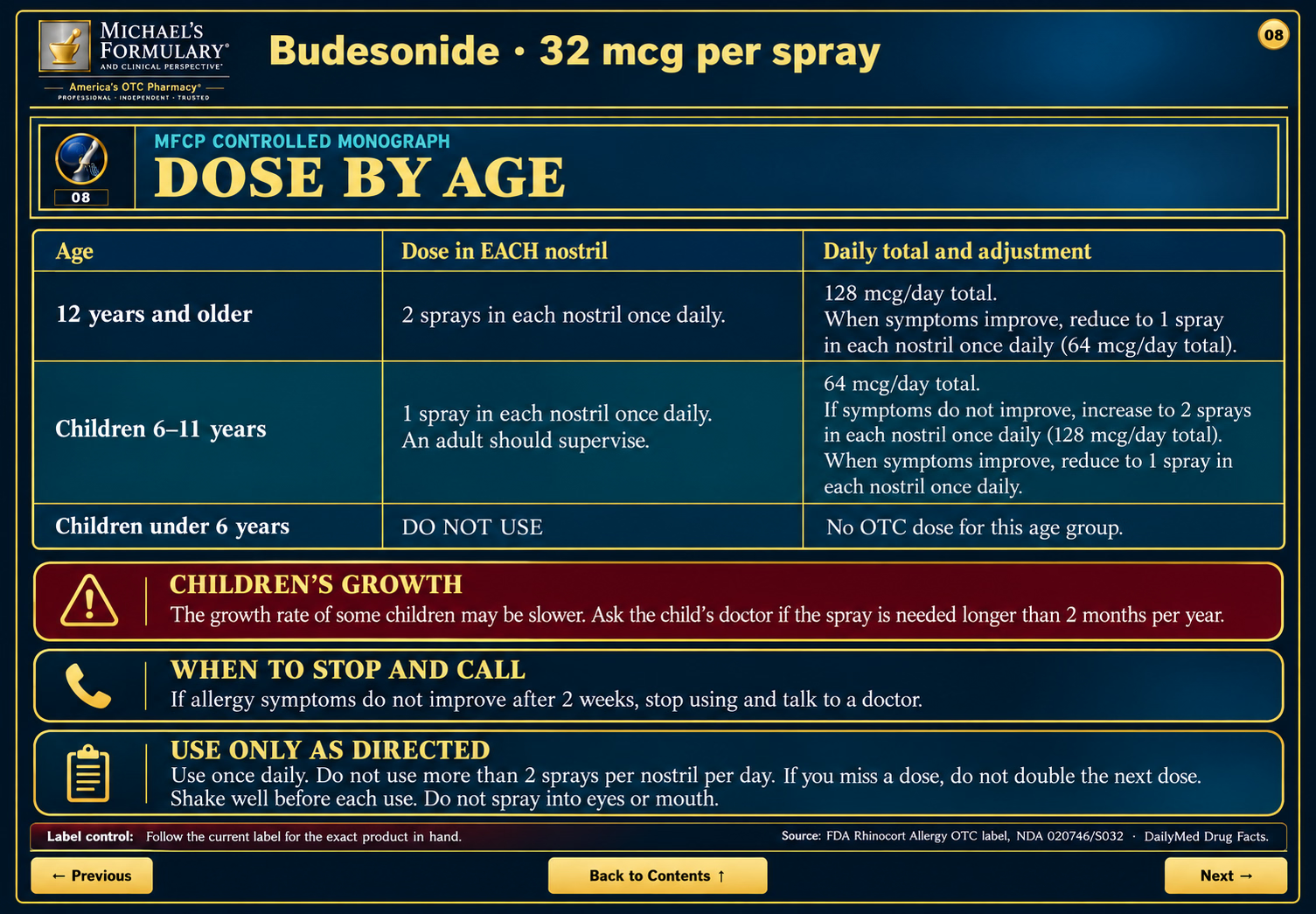
Budesonide — Dose by Age
WhoStarting doseWhen symptoms improve
Adults and ages 12+2 sprays in each nostril once daily (128 mcg/day).Reduce to 1 spray in each nostril once daily (64 mcg/day). Do not use more than 2 sprays per nostril per day.
Children ages 6–111 spray in each nostril once daily (64 mcg/day). An adult should supervise. If symptoms do not improve, the label permits 2 sprays in each nostril per day (128 mcg/day).Reduce to 1 spray in each nostril per day when symptoms improve. Ask the child’s doctor if use is needed for more than two months a year.
Under age 6Do not use.Ask a pediatric clinician about another option.

Do not exceed the label dose. If you miss a dose, do not double the next one. These are OTC directions; prescription dosing is different.

OTC Drug Facts: dose and age controls
Michael’s Formulary & Clinical Perspective™ · Professional Judgment Delivered™
09How to Use the Spray
BUDESONIDE · NASAL ALLERGY CONTROL

How to Use the Spray

Budesonide · 32 mcg per spray

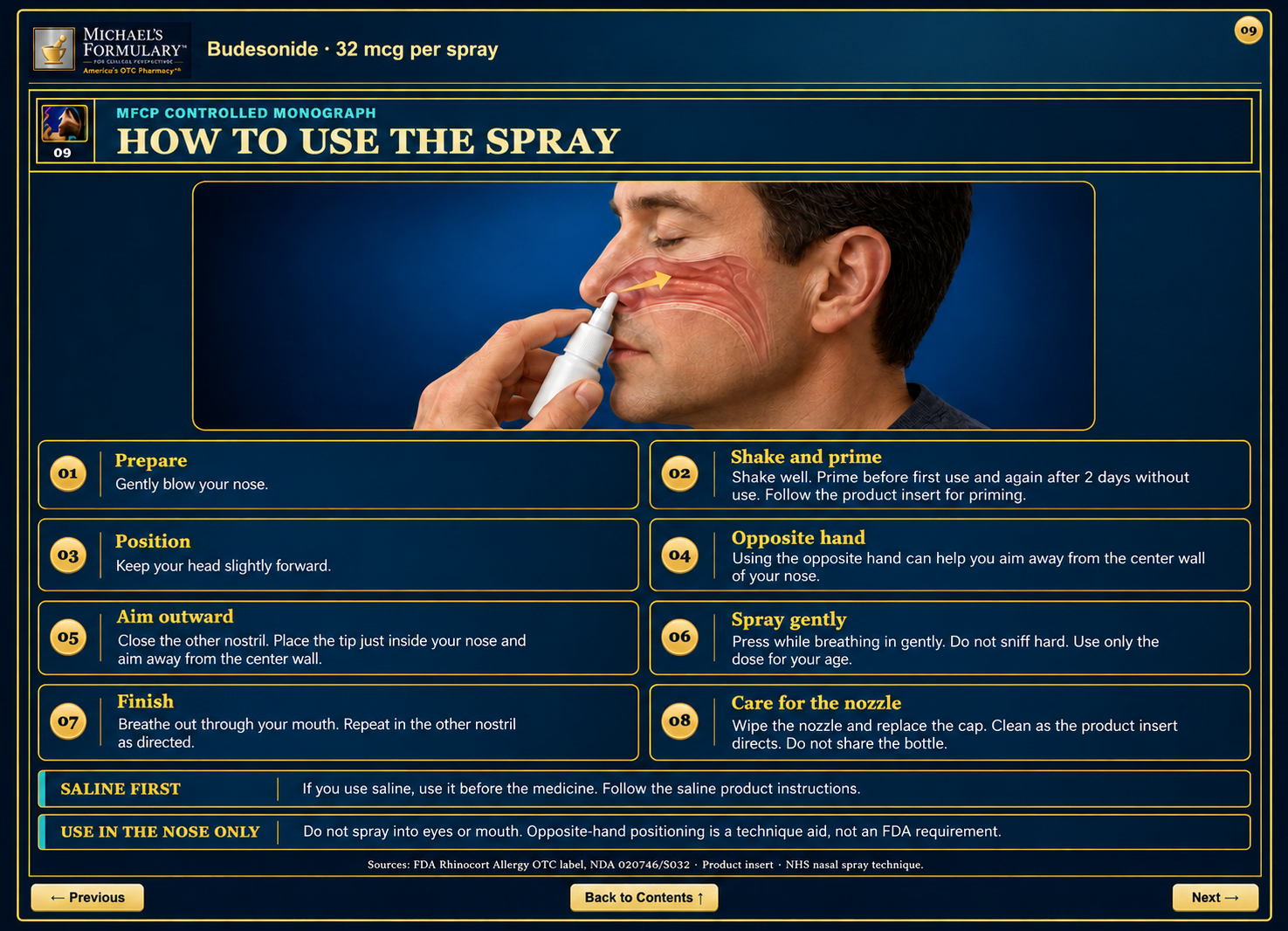
Budesonide — How to Use the Spray
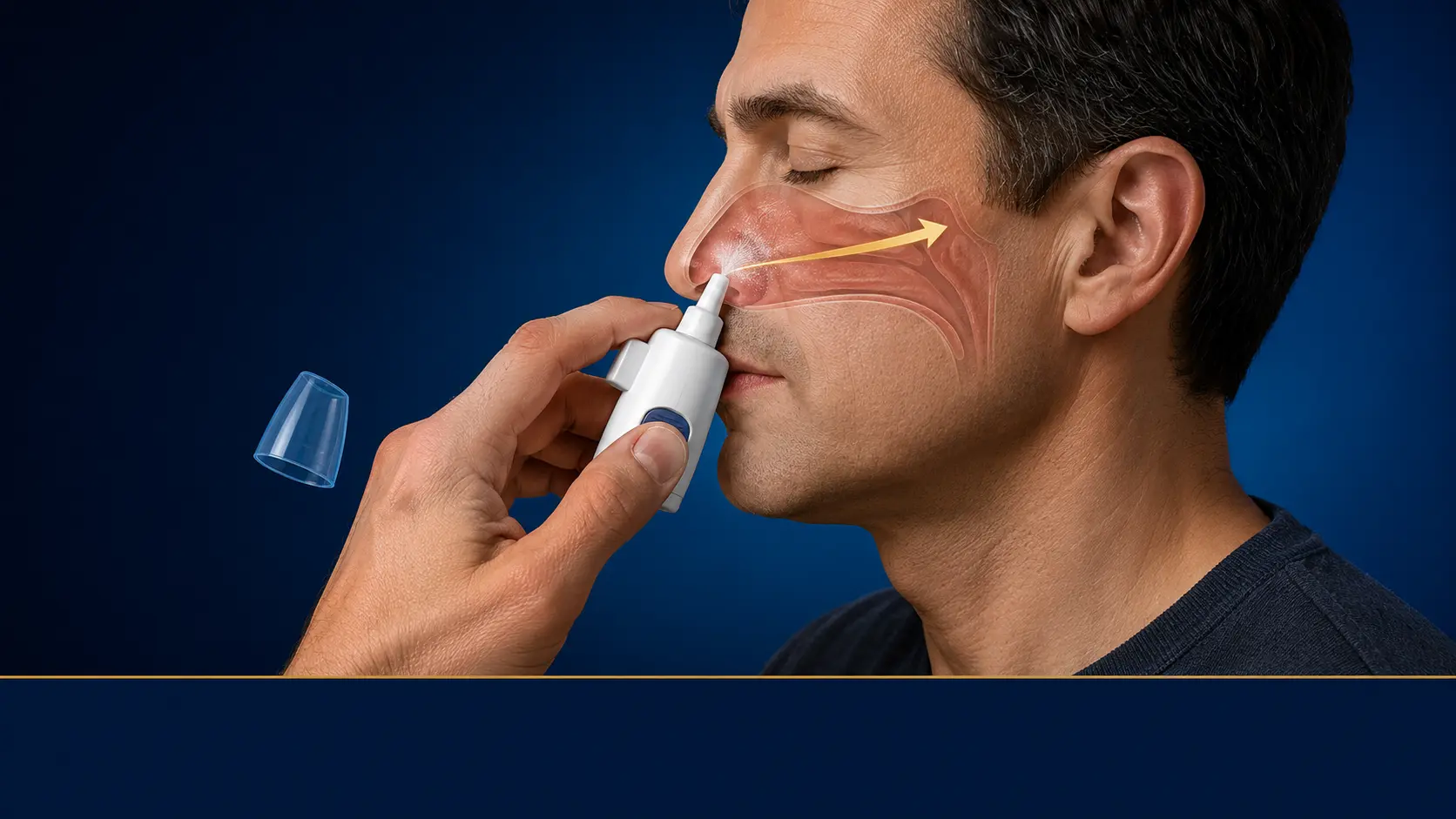
Illustration of outward nasal spray direction; follow Budesonide package priming and dose instructions
  1. PrepareGently blow your nose.
  2. PrimeShake the bottle and prime it exactly as the package directs. Prime again if not used for two days. Follow the exact package insert.
  3. PositionKeep your head upright or slightly forward—not tilted back.
  4. Cross-handUse your right hand for the left nostril and your left hand for the right nostril.
  5. Aim outwardPoint the nozzle away from the center wall of your nose.
  6. Gentle inhalePress while breathing in gently. Do not sniff hard.
  7. FinishBreathe out through your mouth. Repeat only as directed.
  8. CleanWipe the nozzle, replace the cap, and do not share the bottle.
Saline firstIf you use saline, use it before the medicine. Follow the saline product directions.

Use inside the nose only. Do not spray into the eyes or mouth. Shake well before each use. Keep the package insert for priming and cleaning directions.

Michael’s Formulary & Clinical Perspective™ · Professional Judgment Delivered™
10Timing and Expectations
BUDESONIDE · NASAL ALLERGY CONTROL

Timing and Expectations

Budesonide · 32 mcg per spray

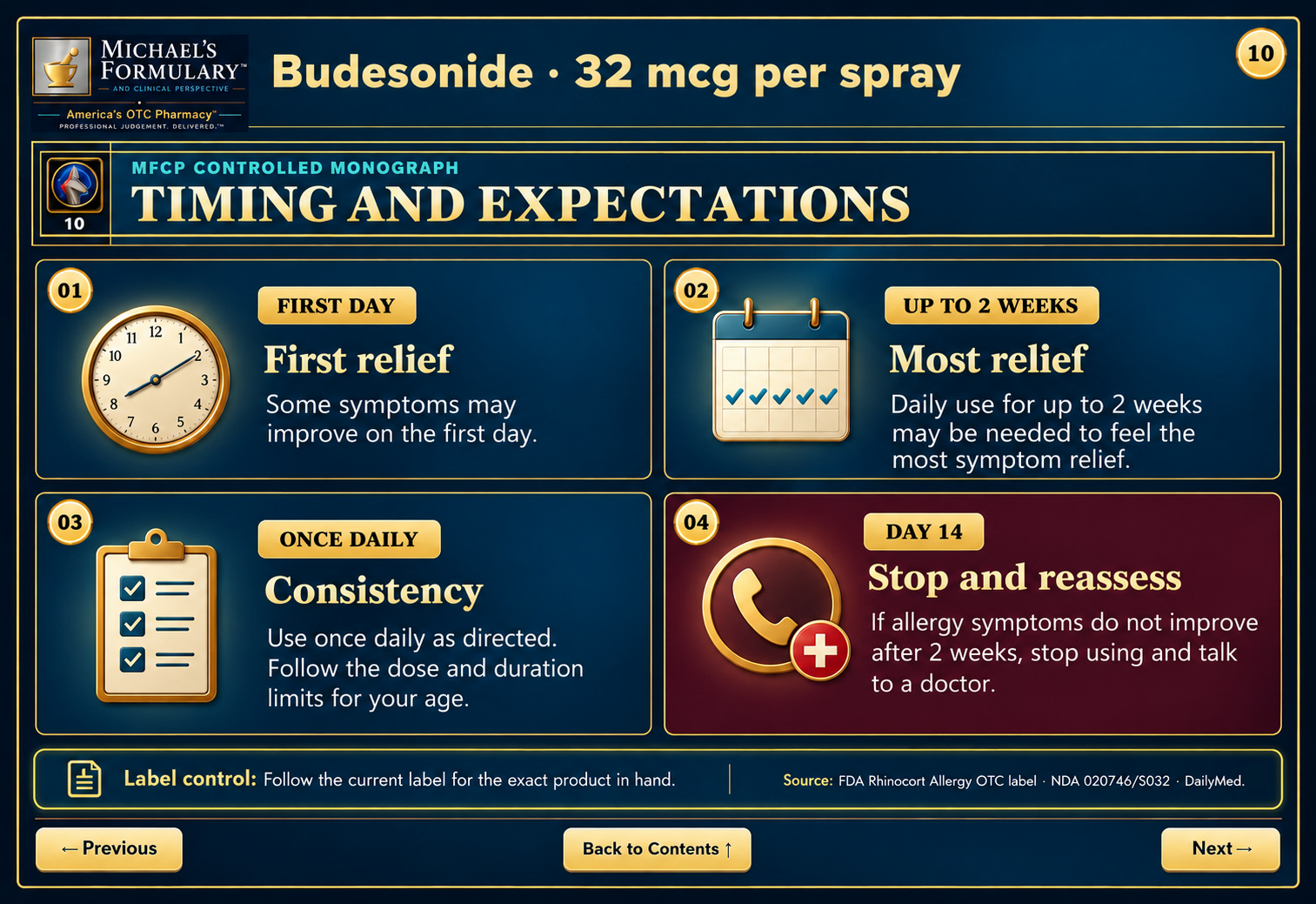
Budesonide — Timing and Expectations
Day 1

First effect

Some symptoms may improve on the first day.

Daily

Consistency

Use it every day during the allergy period.

2 weeks

Most relief

Daily use for up to two weeks may be needed.

Day 14

Reassess

If symptoms have not improved, stop and ask a doctor.

Michael’s Formulary & Clinical Perspective™ · Professional Judgment Delivered™
06
MFCP READING STOP

Stay Safe

12Local Safety
BUDESONIDE · NASAL ALLERGY CONTROL

Local Safety

Budesonide · 32 mcg per spray

Ask before use

  • Recent nose ulcers or nose surgery.
  • A nose injury that has not healed.
  • Other steroid medicines for asthma, allergies or skin rash.
  • An eye infection, glaucoma or cataracts.

Stop and ask a doctor

  • Severe or frequent nosebleeds.
  • Any change in vision.
  • Persistent fever or other signs of infection.
  • Chickenpox, measles or tuberculosis, or contact with someone who has them.

Do not use if you have had an allergic reaction to any ingredient. Do not share the bottle. Keep it out of reach of children.

In case of overdose, get medical help or call Poison Control at 1-800-222-1222 right away.

OTC Drug Facts: warnings
Michael’s Formulary & Clinical Perspective™ · Professional Judgment Delivered™
13Drug and Substance Interactions
BUDESONIDE · NASAL ALLERGY CONTROL

Drug and Substance Interactions

Budesonide · 32 mcg per spray

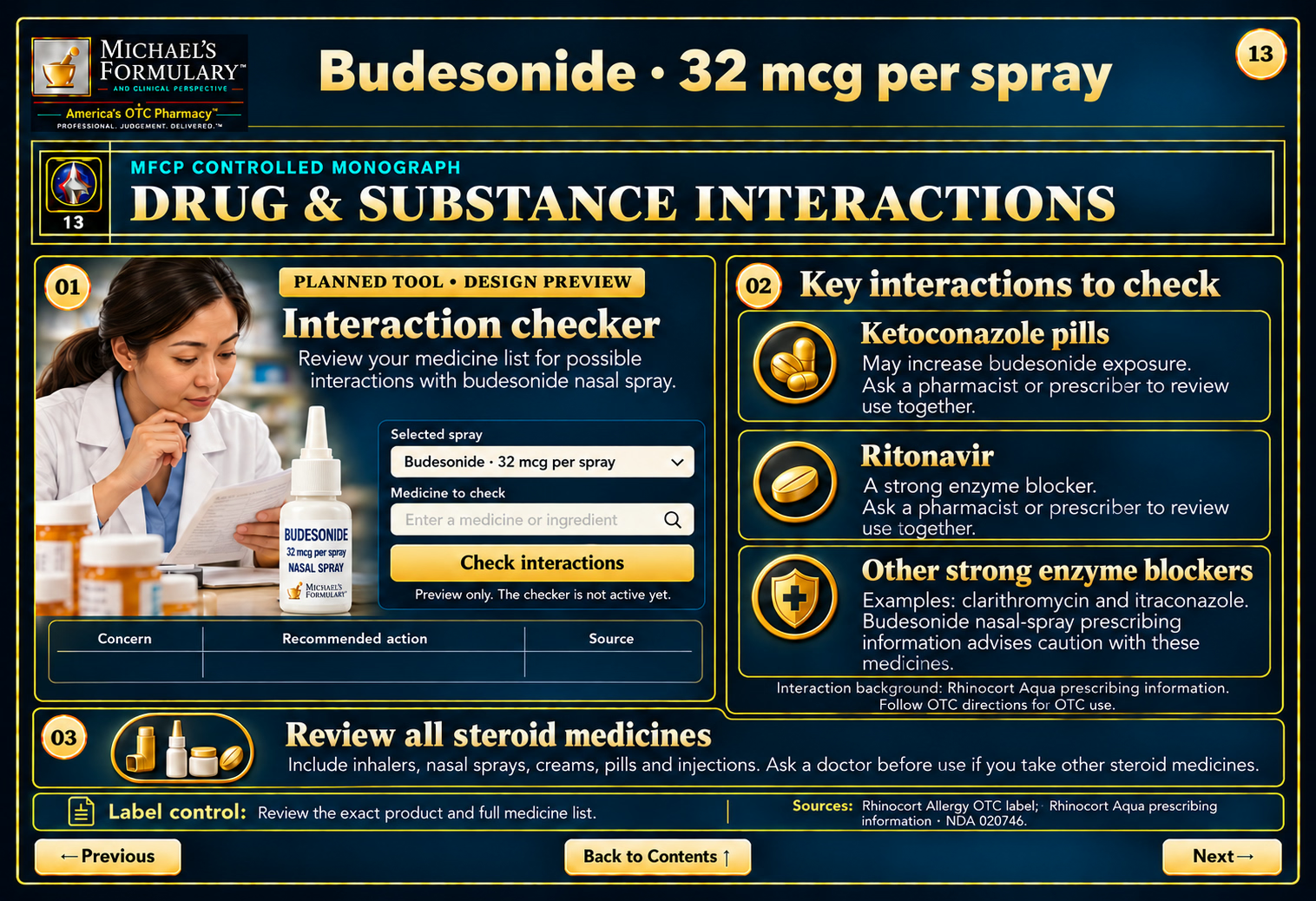
Budesonide — Drug & Substance Interactions

Strong CYP3A4 inhibitors

Strong CYP3A4 inhibitors can raise steroid exposure. Ask a pharmacist to check your full medicine list, especially ketoconazole and other strong inhibitors.

Other steroids

Count inhaled, topical, oral, injected, and nasal steroids when assessing total exposure.

Pharmacist screen: A strong inhibitor or multiple steroid routes requires medication review.

Professional interaction background: Rhinocort Aqua prescribing information. Prescription doses do not replace OTC directions.

Michael’s Formulary & Clinical Perspective™ · Professional Judgment Delivered™
15Special Populations
BUDESONIDE · NASAL ALLERGY CONTROL

Special Populations

Budesonide · 32 mcg per spray

Selected for this monograph

Children

Children

Ages 6–11 · Adult supervision

Pregnancy & breastfeeding

Pregnancy & breastfeeding

A conversation before use

Older adults

Older adults

Eyes · Medicines · Nosebleeds

Liver health
Eye conditions
Kidney health
Diabetes
Heart health
Caregivers
Patient-friendly nasal allergy illustration

The selected cards open the guidance below. Other conditions may also need review. Tell your clinician about liver disease or other health concerns.

Children

Dose

Start with 1 spray in each nostril once daily. An adult should supervise.

Step up and down

If symptoms do not improve, the label permits 2 sprays in each nostril per day. Return to 1 spray when symptoms improve.

Growth and longer use

Some children may grow more slowly. Ask the child’s doctor if use is needed for more than two months a year.

Under age 6

Do not use.

Source: OTC Drug Facts

Pregnancy & breastfeeding

Before use

Ask a health professional before use if you are pregnant or breastfeeding.

Your care plan

Bring the bottle and your full medicine list to your visit. Discuss symptom control and the right dose for you.

Source: OTC Drug Facts

Pregnancy evidence

Observational data on nasal budesonide have not shown an overall increase in birth defects. These data do not prove zero risk. Review the choice before use.

Historical prescription label: pregnancy background

Breastfeeding evidence

Expert reviews consider nasal corticosteroids acceptable during breastfeeding. Milk studies were of inhaled budesonide, not this nasal spray. Ask a health professional before use as the OTC label directs.

LactMed: Budesonide, 15 January 2026

Older adults

Eyes

Ask a doctor before use about an eye infection, glaucoma or cataracts.

Nosebleeds

Stop and ask a doctor for severe or frequent nosebleeds.

Other medicines

Tell your doctor about all medicines, including other steroids. Ask a pharmacist to check for interactions.

Source: OTC Drug Facts

Liver disease deserves a review

Budesonide is cleared mainly by the liver. Liver disease may increase the amount in the blood. Tell your clinician if you have liver disease, including fatty liver disease, so they can assess whether closer monitoring is needed.

Professional source: hepatic impairment

Portraits are AI illustrations. Clinical wording checked 8 October 2026. OTC directions remain the dose control.

Michael’s Formulary & Clinical Perspective™ · Professional Judgment Delivered™
11Verify the product. Use it safely.
BUDESONIDE · NASAL ALLERGY CONTROL

Verify the product. Use it safely.

Budesonide · 32 mcg per spray

Budesonide 32 mcg per spray package example; compare your current Drug Facts

Verify the package

  • Budesonide, 32 mcg per spray.
  • Nasal spray: not an inhaler, capsule or other budesonide form.
  • Current Drug Facts, age statement, spray count and expiration.
  • Intact tamper seal. Keep the carton and insert.

Use safely

  • Inside the nose only.
  • Shake well before each use.
  • Do not share the bottle.
  • Do not double a missed dose.

Check the exact medicine before buying. Budesonide 32 mcg and fluticasone propionate 50 mcg have different labels and doses.

Michael’s Formulary & Clinical Perspective™ · Professional Judgment Delivered™
07
MFCP READING STOP

Buy the Right Bottle

14MFCP Buying Standard™ · Product Identifier™
BUDESONIDE · NASAL ALLERGY CONTROL

MFCP Buying Standard™ · Product Identifier™

Budesonide · 32 mcg per spray

MFCP Editorial Control

Clinical Product Identification

Rhinocort Allergy carton labeled Budesonide nasal spray, 32 mcg per spray; historical package example
Active ingredient
Budesonide
Strength
32 mcg per spray
Dosage form
Metered intranasal aqueous suspension
Product
Rhinocort Allergy or a properly matched store-brand equivalent

Confirm budesonide 32 mcg per spray on the Drug Facts panel.

Budesonide · 32 mcg per spray · intranasal use
Retail Partner Opportunity

Price, Availability & Purchase Pathway

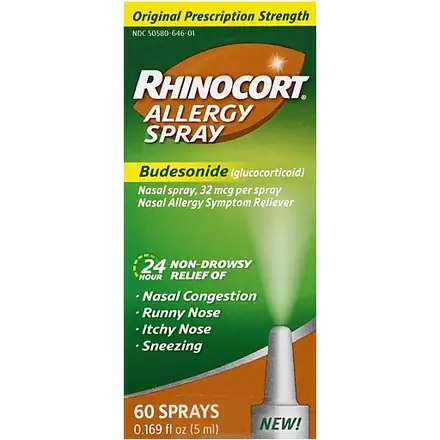
Supplied authentic Rhinocort Allergy bottle and package artwork, budesonide nasal spray

Rhinocort® Allergy Nasal Spray

Budesonide · 32 mcg per spray
Michael’s Formulary & Clinical Perspective — America’s OTC Pharmacy
$5299 Reference price
Size: check the exact package and spray count.
Top highlights
Active ingredient: budesonide. Route: intranasal.
Item details
Match the current Drug Facts, age statement and expiration.
Measurements
Confirm the spray count on the package in hand.
See all product specifications
Similar item to consider
MFCP retail reference · supplied price is a layout example; verify the current offer and package.
Understand → Identify → Compare → Purchase

Editorial control. Product identification stays independent of the retailer.

Advertising reference. No sponsorship is represented. Amazon opens a search, not a checkout.

MFCP IDENTIFIER 2.0 · FORMULATION CONTROL

Scent-free and alcohol-free

Formulation
Scent-free, alcohol-free aqueous suspension
Clinical reason
An option when fragrance or alcohol led a patient to abandon another spray
Appearance
White aqueous suspension in a metered nasal pump
Do not assume
Package color alone does not establish product equivalence

Match the formulation and complete Drug Facts label—not the package color.

Package control

Confirm the seal, spray count, expiration, and current Drug Facts.

Michael’s Formulary & Clinical Perspective™ · Professional Judgment Delivered™
16Clinical Comparison
BUDESONIDE · NASAL ALLERGY CONTROL

Clinical Comparison

Budesonide · 32 mcg per spray

Budesonide — Clinical Comparison

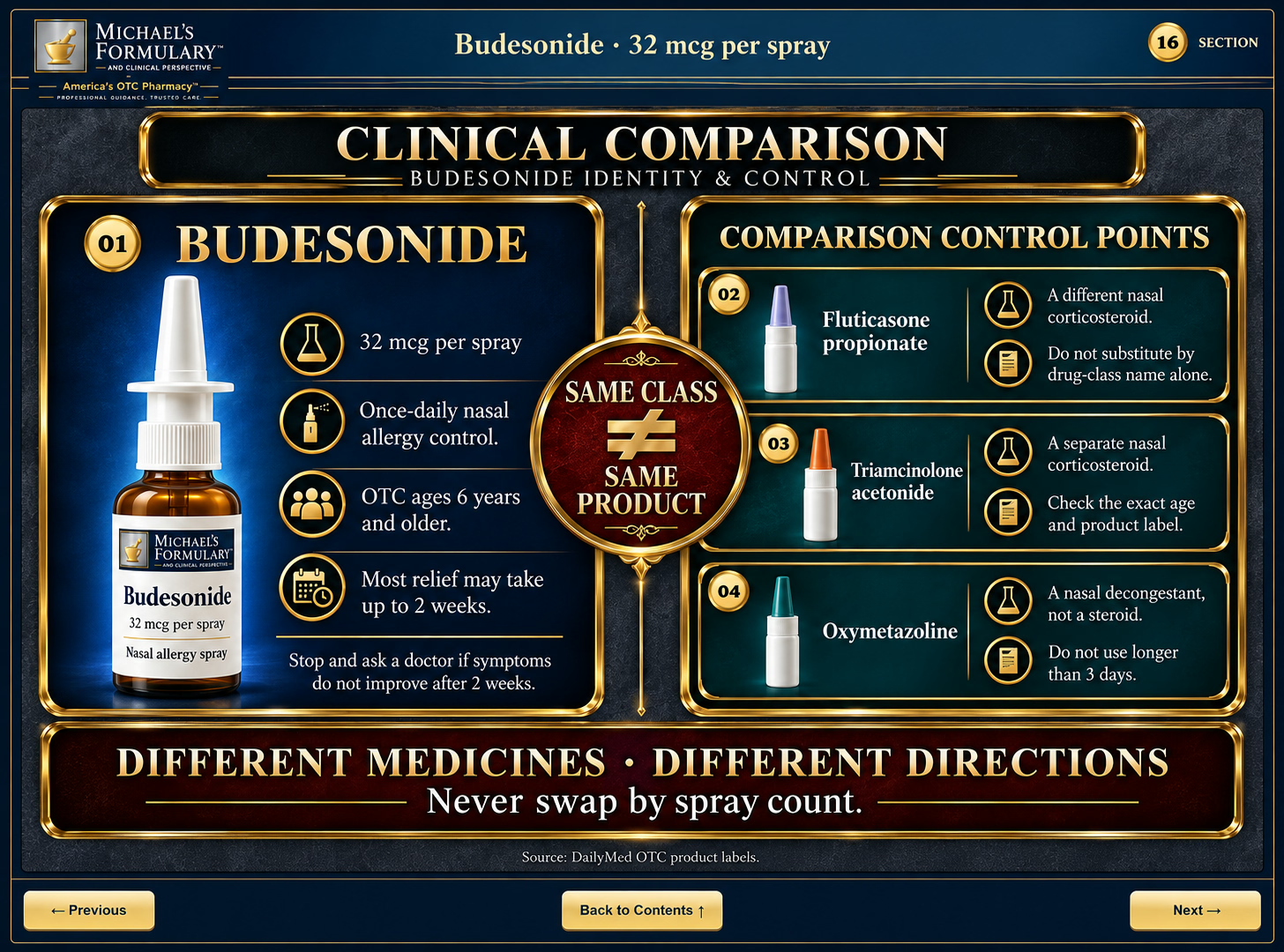
Three distinct nasal-spray identities

Different medicines. Different strengths. Different age directions.

ProductStrength per sprayMinimum OTC ageIf not better
Budesonide32 mcg6 yearsStop use and ask a doctor after two weeks.
Fluticasone propionate50 mcg4 yearsStop use and ask a doctor after seven days.
Triamcinolone acetonide55 mcg2 yearsStop use and ask a doctor after one week.

Do not switch by spray count. Match the full drug name, strength, age and package guide. Micrograms per spray do not rank clinical benefit. See Stop 05 (Use It Right) for each age group's dose.

Propionate and furoate are different. Fluticasone furoate is a separate product. Its directions are not the propionate directions shown here.

Decongestant boundary. Oxymetazoline is not a steroid. Its OTC limit is three days.

Controls: the current Drug Facts sources in Stop 08 (Ask and Verify) for each named product. Check the exact package in hand.

Michael’s Formulary & Clinical Perspective™ · Professional Judgment Delivered™
08
MFCP READING STOP

Ask and Verify

17Counseling Pearls and Triage
BUDESONIDE · NASAL ALLERGY CONTROL

Counseling Pearls and Triage

Budesonide · 32 mcg per spray

Finding / checkAction
Is this an allergy pattern?
Confirm symptoms and duration; refer if infection or another cause is likely.
Is the exact product correct?
Read the full generic name and strength: Budesonide, 32 mcg per spray. Follow the age directions; do not use under age 6.
Is spray technique correct?
Head slightly down, opposite hand, aim outward, gentle inhale. Follow the exact package guide for priming and cleaning.
No improvement after two weeks of correct daily use
Stop use and reassess diagnosis, adherence, and technique with a doctor.
Severe or frequent nosebleed
Stop use and ask a doctor.
Exposure to chickenpox, measles, or tuberculosis
Stop use and ask a doctor.
Persistent fever or another sign of infection
Stop use and obtain clinical assessment. These symptoms may have a cause other than allergies.
Any new vision change
Stop use and ask a doctor promptly.
Other steroids, eye disease or recent nose injury
Ask a doctor before use if you use another steroid, have eye disease, or have recent nose surgery, ulcers or an injury that has not healed.
Allergic reaction
Stop use. If breathing is difficult or the lips, tongue or throat swell, call 911. Get medical help right away for an allergic reaction.

For children ages 6–11, talk to the child’s doctor if the spray is needed for longer than two months a year.

Michael’s Formulary & Clinical Perspective™ · Professional Judgment Delivered™
18Evidence and Source Control
Michael’s Formulary & Clinical Perspective — MFCP

Budesonide · 32 mcg per spray

18
MFCP CONTROLLED MONOGRAPH

Evidence and Source Control

  1. MFCP Deep DiveMFCP Budesonide Deep Dive · July 25, 2026
  2. Monograph and FNID prototypesBudesonide monograph and FNID prototypes · July 28, 2026
  3. Monograph controlMFCP Budesonide monograph control · August 19, 2026
  4. Current label controlsThe Drug Facts label for the product in hand controls dosing, age limits, warnings, and priming instructions.
Editorial boundaryThis page summarizes the controlled source documents. It does not replace the package label, a diagnosis, or emergency care.

Clinical sources and their roles

  1. Johnson & Johnson Consumer Inc. (2023, March 21). Rhinocort Allergy: budesonide 32 mcg per spray [OTC Drug Facts]. DailyMed. Dose, ages, symptom relief, warnings, priming and stop rules.
  2. Equate. (2025, May 16). Budesonide nasal spray [OTC Drug Facts]. DailyMed. Independent current OTC identity and safety check.
  3. AstraZeneca. (2010, December). Rhinocort Aqua nasal spray [Prescribing information]. DailyMed. Professional chemistry, interaction, liver and local safety background. This historical prescription label is not the OTC dose control.
  4. Petersen, H., Kullberg, A., Edsbäcker, S., & Greiff, L. (2001). Nasal retention of budesonide and fluticasone in man: Formation of airway mucosal budesonide-esters in vivo. British Journal of Clinical Pharmacology. https://doi.org/10.1111/j.1365-2125.2001.01303.x. Human nasal-biopsy evidence for the local retention explanation.

Clinical source pages rechecked 11 October 2026. Use the current Drug Facts and insert for the exact product in hand. AI illustrations do not authenticate a product or prove an atom-by-atom molecular structure.

Michael’s Formulary & Clinical Perspective™ · Professional Judgment Delivered™
Readability and literacy
19Health Literacy and Readability Control
BUDESONIDE · NASAL ALLERGY CONTROL

Health Literacy and Readability Control

Budesonide · 32 mcg per spray

The readability score measures selectable clinical text. It does not measure words embedded in artwork.

Readability of this refined reader

Measured grade: 6.2. Target: grade 8 or below.

Reading Ease: 63.4. Measured 1,422 words, 194 sentences or fragments, and 2,286 estimated syllables. Checked 11 October 2026.

Scope: patient guidance, paragraphs, table body cells, leaf list items and definitions. Navigation, headings, sources, this disclosure and artwork lettering are excluded. Short fragments count as at least one sentence.

The estimate uses the Flesch–Kincaid formula and CMU pronunciation syllables with a vowel-group fallback. It does not test understanding or certify clinical accuracy.

The retained original reference reports 7.9 for its 397-word sample. That historical claim is separate from this newly measured reader.

Original disclosure and its scope
Michael’s Formulary & Clinical Perspective™ · Professional Judgment Delivered™

Source links

Links already cited on this page.