Skip to content
MFCP mortar and pestle emblemMichael’s FormularyCLINICAL PERSPECTIVE™

Clinical library / Digestive health

The American OTC Product Atlas™ · Section 4

Gastrointestinal OTC Clinical Pathways

Four distinct treatment lanes. Start with the symptom pattern, separate immediate relief from sustained control, and stop self-care when alarm features appear.

Choose the mechanism that matches the problem

The gastrointestinal decision map

These categories are not interchangeable. Antacids act on acid already present; H₂-receptor antagonists and proton-pump inhibitors reduce secretion; antidiarrheals slow or protect; laxatives address constipation through several different mechanisms.

Live monographIn development
01
Rapid acid neutralization

Calcium Carbonate (CaCO3)

Fast-acting chemical buffer for acute, episodic gastric distress.

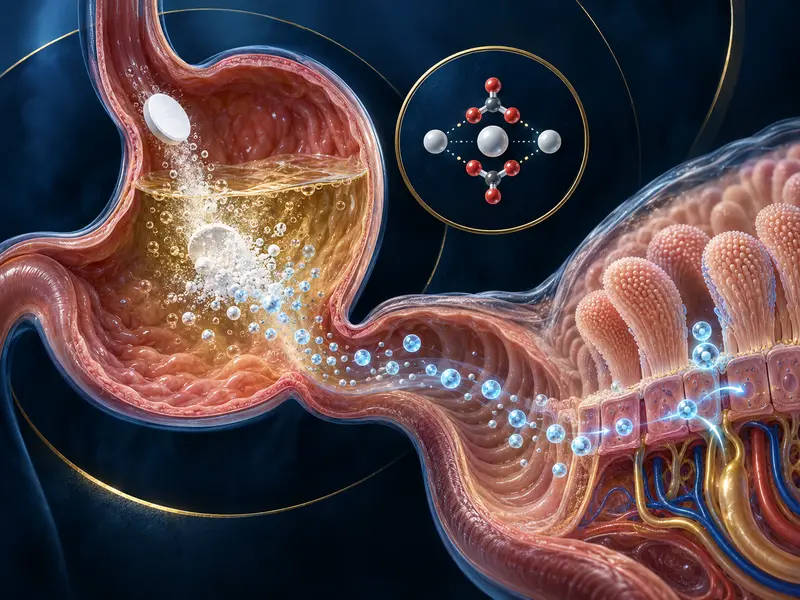
Calcium carbonate tablets dissolving in gastric acid within the stomach
The acid crush · intragastric bufferingCaCO3 + 2HCl → CaCl2 + H2O + CO2 ↑
StandardChewable tabletsUltra StrengthChewable tabletsAlternative FormsSoft chews · liquids
Best FitBreakthrough post-meal heartburn, predictable dietary flares, or nighttime burning after heavy food
Speed vs. StayRelief can begin in 5–15 minutes; duration depends strongly on meal timing and gastric emptying
The Trade-OffStrong neutralization with carbon-dioxide gas, belching, fullness, and constipation risk
Hard RuleCalcium can bind critical oral medicines—follow the interacting drug's exact spacing directions
Immediate neutralization does not diagnose the cause of recurrent pain, reflux, or chest symptoms.
02
Two routes to less acid

H₂ Blockers & Proton-Pump Inhibitors
H₂ blockers reduce the upstream histamine signal. PPIs disable the final acid-secretion machinery. The destination is shared; the pathway, timing, and clinical job are not.

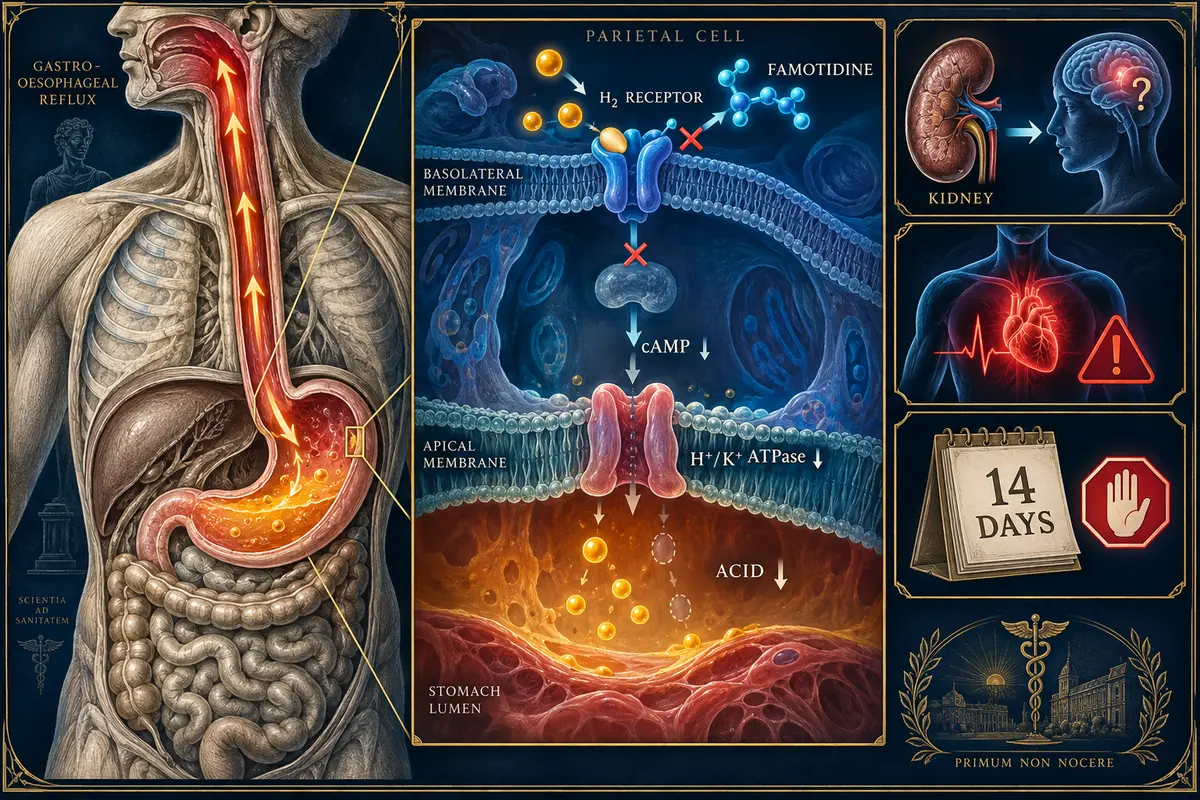
Parietal-cell H2 receptor pathway showing famotidine blocking histamine signaling and reducing proton-pump activation
Image 01 · H₂ blockadeReduce the upstream signal

Histamine signal interrupted

Blocking the basolateral H₂ receptor lowers cAMP signaling, so fewer proton pumps are driven into high-output acid secretion. Relief is comparatively rapid and useful around predictable triggers.

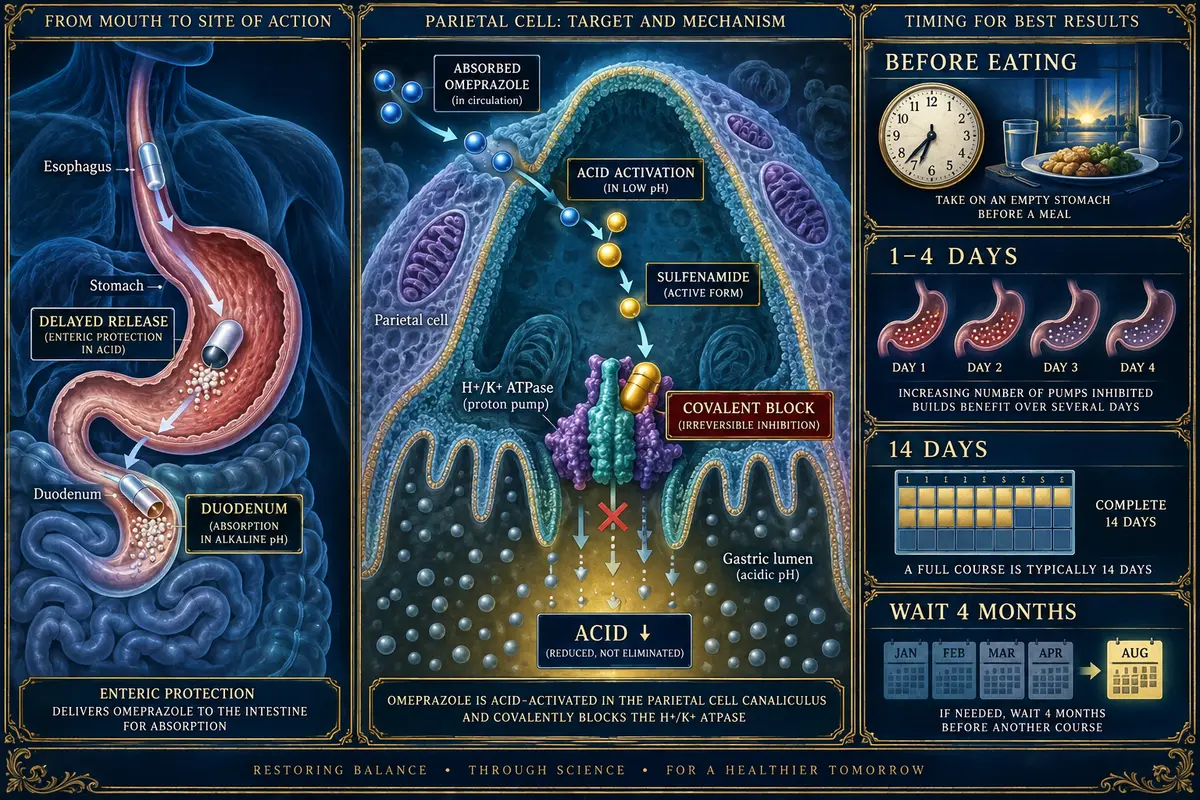
Parietal-cell canaliculus showing the gastric proton pump exchanging hydrogen and potassium ions before proton-pump inhibition
Image 02 · Final pumpDisable the acid-secretion endpoint

H⁺ out · K⁺ in

The H⁺/K⁺-ATPase secretes hydrogen into the gastric lumen in exchange for potassium. Acid-activated PPIs covalently disable active pumps; benefit builds over repeated daily doses.

H₂ Class DifferencesFamotidine · OTC lead; kidney function matters; comparatively limited CYP burdenCimetidine · substantially greater interaction burden; liver and kidney review
PPI Class DifferencesOmeprazole / Esomeprazole · CYP2C19 and clopidogrel controlLansoprazole · different metabolic profile; still requires medication review
Class controlH₂ blockers are not miniature PPIs. PPIs are not rescue antacids. Do not casually stack acid suppressors.
The current Drug Facts label controls age, timing, maximum use, interactions, and treatment duration.
03
Fluid loss, stool frequency & cause

Antidiarrheal Agents

Bismuth subsalicylate and loperamide answer different clinical questions. Product selection starts with hydration status, duration, fever, blood, travel or antibiotic exposure, age, and medication risk.

Bismuth laneBismuth subsalicylate products, including current Kaopectate formulations
Motility laneLoperamide for label-appropriate acute diarrhea
PriorityReplace fluid and electrolytes
Brand name alone is not ingredient identity. Read the current Active ingredient line every time.
04
Constipation is not one mechanism

Laxative Families

First identify the mechanism. Then identify the source. A botanical, mineral, or manufactured ingredient can occupy a very different clinical lane—even when every product is marketed for constipation.

MFCP classification ruleNatural describes origin—not potency, gentleness, or safety.
Bulk-formingOsmoticSalineStimulantStool softenerRectal
Natural product lane 01

Plant-Derived Actives

Botanical origin with a defined pharmacologic job—not a universal “gentle” category.

  • Psyllium / PlantagoBulk-forming fiber
  • SennaStimulant laxative
  • Castor oilStimulant laxative
Natural product lane 02

Mineral-Derived Actives

Naturally occurring salts whose clinical limits are driven by fluid, electrolyte, and kidney effects.

  • Magnesium hydroxideSaline laxative
  • Magnesium citrateSaline laxative
  • Sodium phosphatesRectal saline option
Formulated therapeutic lane

Manufactured Actives

Engineered or highly processed ingredients classified by their physiological action.

  • PEG 3350Osmotic laxative
  • MethylcelluloseBulk-forming agent
  • DocusateStool softener
Nutrition & wellness lane

Food-Based Support

Dietary strategies may support regularity, but they are not automatically interchangeable with OTC drugs.

  • Prunes / kiwiWhole-food support
  • Flax / chiaFiber-containing foods
  • Dietary fiberDaily pattern support
Drug FactsOTC laxative drug
Supplement FactsDietary supplement
Nutrition FactsFood product
The label decides the regulatory lane.
Clinical controlMatch the mechanism to the patient—not the marketing language. “Natural” does not cancel dehydration, cramping, electrolyte, interaction, or obstruction risk.
Persistent constipation, marked distention, vomiting, rectal bleeding, or inability to pass gas requires evaluation.
Begin with the presentation

What are you treating?

A familiar symptom pattern may fit self-care. A new, progressive, severe, or unexplained presentation belongs outside the OTC aisle.

Acute diarrheaAssess hydration, duration, blood, fever, and exposure first.
Open pathway →
Clinical red-line gate

Stop self-care.

OTC symptom control should never delay assessment of bleeding, obstruction, dehydration, progressive disease, or a cardiac presentation.

Vomiting blood, red blood in stool, or black tarry stool
Trouble or pain swallowing, persistent vomiting, or unexplained weight loss
Severe, localized, worsening, or rigid abdominal pain
Bloody diarrhea, high fever, marked weakness, or dehydration
Constipation with vomiting, major distention, or inability to pass gas
Chest pressure, shortness of breath, sweating, faintness, or spreading pain
MFCP BOTTOM LINE: name the symptom, identify the active ingredient, match the mechanism, read the current Drug Facts label, and keep alarm symptoms outside self-care.
Michael's Formulary & Clinical Perspective, PLLC · Professional Judgment. Delivered.™Clinical education · not a diagnosis or substitute for individualized care
Contents
  1. Calcium Carbonate (CaCO 3 )
  2. H₂ Blockers & Proton-Pump Inhibitors
  3. Antidiarrheal Agents
  4. Laxative Families