
Recognize the symptom
Phenazopyridine temporarily relieves urinary pain, burning, urgency, and frequency.

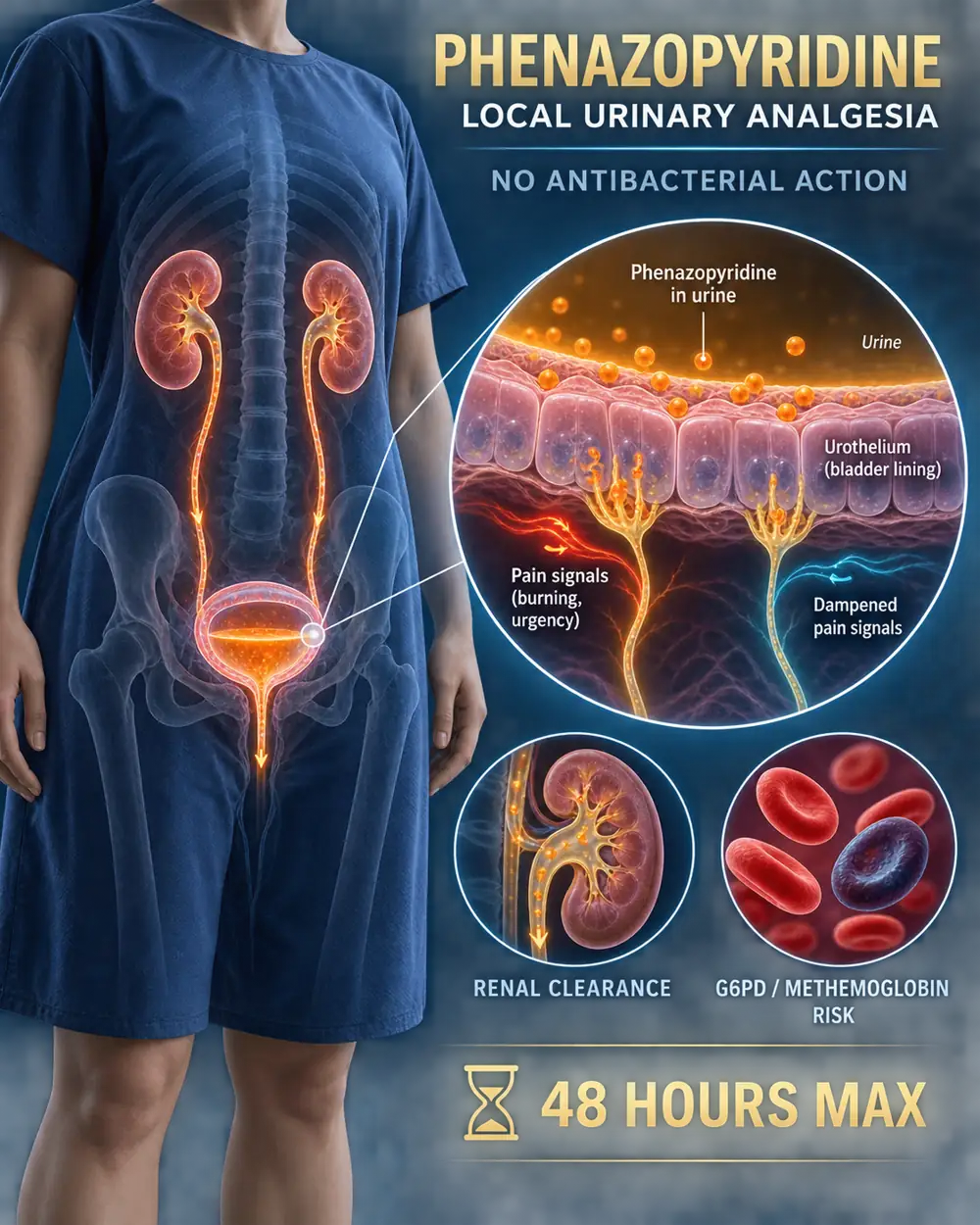
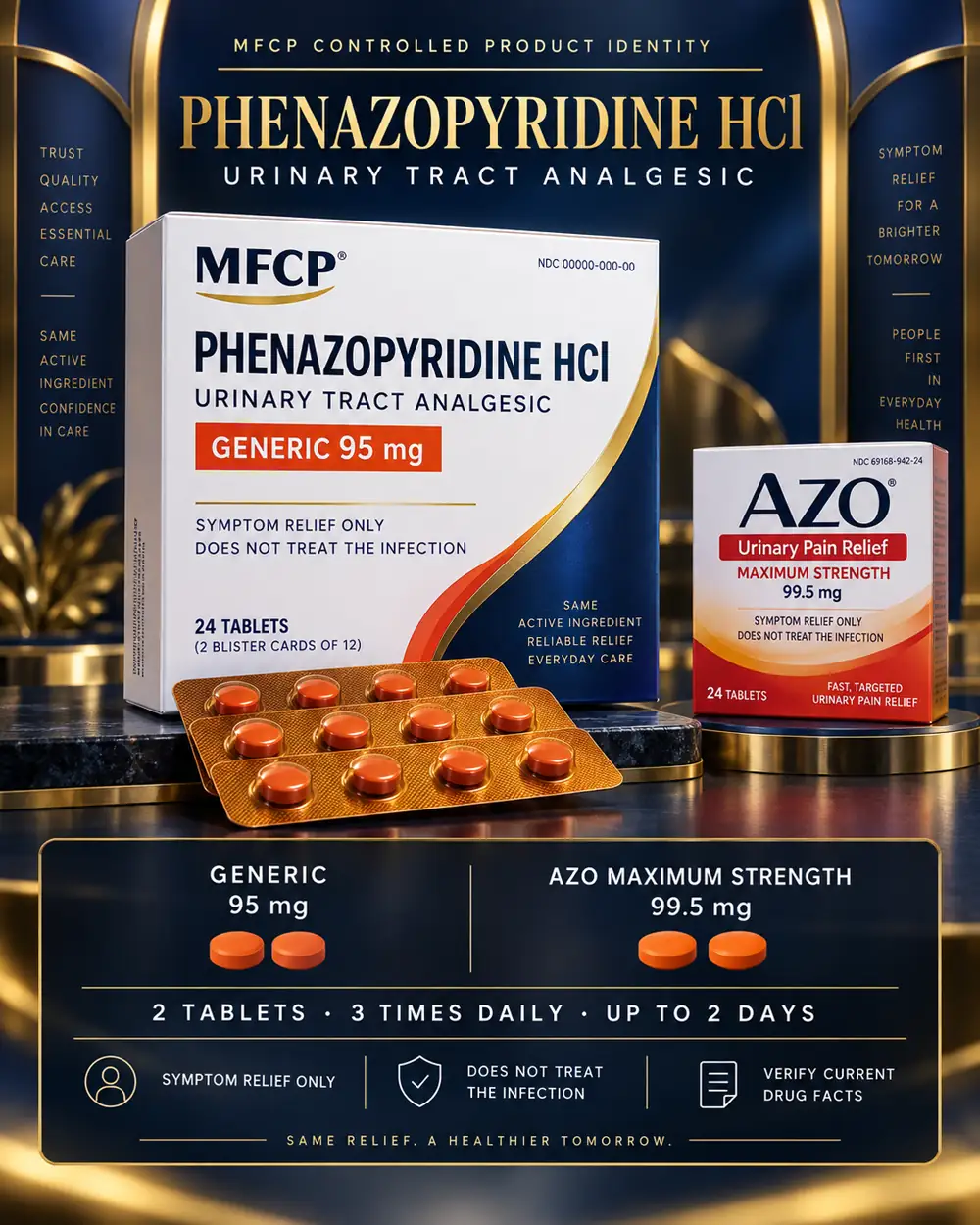
Phenazopyridine temporarily relieves urinary pain, burning, urgency, and frequency. It changes sensation and urine color—it does not diagnose, eradicate, or prevent a urinary infection.
Relieve the burning without hiding the diagnosis.
Phenazopyridine temporarily relieves urinary pain, burning, urgency, and frequency.
Dysuria may reflect infection, stone, obstruction, vaginitis, STI, trauma, or another condition.
OTC use is limited to up to 2 days unless a doctor directs otherwise.
Phenazopyridine has no antibacterial action.
Generic identity first; reference brand second.
A urinary tract analgesic azo dye with local action at the urinary mucosa.
Short-term symptom relief while the cause of dysuria is evaluated and treated.
Renal accumulation, G6PD-related hemolysis, methemoglobinemia, and diagnostic interference.
Orange-red color is pharmacology—not proof of bleeding.
The active ingredient must be verified on the current Drug Facts panel.
It is not an antibiotic and not a general systemic pain reliever.
Generic and reference-brand tablets may differ slightly in unit strength.
Representative DailyMed labels state the products have not been found FDA-approved as safe and effective.
The precise molecular target remains incompletely characterized.
Drug excreted into urine contacts the lining of the lower urinary tract.
Burning, pain, urgency, and frequency may temporarily improve.
It does not eradicate organisms, sterilize urine, or prevent ascending infection.
Accumulation converts a short bridge into a toxicity risk.
Treat the patient’s cause, not the shelf category.
Temporary relief while evaluation or prescribed treatment begins.
Antibiotic selection requires diagnosis and clinical judgment.
Symptoms beyond two days require medical evaluation.
Fever, chills, flank pain, vomiting, or systemic illness may signal pyelonephritis.
The 48-hour ceiling is both dosing and diagnostic control.
Children under 12: do not use without consulting a doctor.
Verify whether each tablet is 95 mg or 99.5 mg.
Take with or after meals and with a full glass of water.
Do not use more than 12 tablets without consulting a doctor.
Analgesia must not become diagnostic camouflage.
Burning, urgency, frequency, and pain can lessen even when infection persists.
Urinalysis, culture, history, examination, pregnancy status, and local resistance can matter.
Antibacterial therapy, when indicated, must target the organism and patient context.
Prepare the patient before the first dose.
This expected dye effect is described as not harmful on current labels.
Protect clothing, surfaces, and other items.
Wash hands after handling tablets and follow package precautions.
Visible blood, clots, pain, or uncertain timing still requires assessment.
Tell the laboratory and clinician about recent use.
| Test or device | Problem | Controlled action |
|---|---|---|
| Urine dipstick or colorimetric assay | Orange-red pigment can obscure or distort color reactions, including glucose and ketone testing. | Disclose phenazopyridine use; use methods the laboratory considers reliable. |
| Urinalysis before treatment | Starting the dye first can complicate interpretation. | When clinically feasible, obtain the urine specimen before the first dose. |
| Urine culture | Phenazopyridine is not antibacterial, but sampling timing still affects the diagnostic pathway. | Do not delay culture when it is clinically indicated. |
| Pulse oximetry during suspected methemoglobinemia | Standard readings can be misleading. | Emergency evaluation may require blood co-oximetry. |
Do not invent a numeric cutoff from a consumer label.
Reduced clearance increases parent-drug and metabolite exposure.
The current AZO package insert identifies liver trouble for professional review.
Unexpected yellow discoloration may signal accumulation or hepatic injury and requires prompt evaluation.
Oliguria, swelling, severe weakness, or confusion is not a self-care situation.
The current OTC label makes G6PD deficiency a do-not-use condition unless physician-approved.
Limited antioxidant capacity increases vulnerability to oxidant metabolites.
Dark urine, rapid pulse, breathlessness, or weakness requires urgent assessment.
Accumulation can magnify oxidative blood toxicity.
Oxidized hemoglobin cannot carry oxygen normally.
Dysuria in pregnancy deserves a low threshold for evaluation.
Current AZO labeling recommends a pregnancy test and consultation if pregnancy is confirmed.
Pregnancy changes the significance of urinary symptoms and the treatment pathway.
Consider infant age, G6PD status, maternal kidney function, and whether an alternative is preferable.
A short duration does not erase risk.
Do not extrapolate adult OTC directions.
Age-related loss of kidney function can increase accumulation risk.
Diuretics, anticoagulants, SGLT2 inhibitors, anticholinergics, and recent antibiotics alter the clinical picture.
Instrumentation-related discomfort may fit a different diagnostic and treatment pathway.
Burning, spasm, and infection are different targets.
| Agent | Primary role | Antimicrobial? | Distinctive control |
|---|---|---|---|
| Phenazopyridine | Local urinary mucosal analgesia | No | Two-day OTC ceiling; orange-red urine; renal/G6PD risk |
| Methenamine combinations | Urinary antiseptic in suitable acidic urine, often with additional ingredients | Condition-dependent | Formula-specific interactions and contraindications |
| Flavoxate | Bladder smooth-muscle antispasmodic | No | Obstruction and CNS/visual adverse-effect screening |
| Antibiotic | Treat susceptible bacterial infection | Yes | Diagnosis, organism, site, patient factors, and stewardship |
AZO is the reference brand—not the ingredient.
Do not confuse urinary pain relief with cranberry, methenamine, or combination products.
Verify the exact tablet strength and package directions.
The product relieves symptoms; it does not treat infection.
Brand familiarity never overrides the active ingredient, duration, warnings, lot, or expiration.
The symptom may be lower-tract; the danger may not be.
Fever, chills, flank or back pain, vomiting, or systemic illness.
Inability to urinate, severe colicky pain, clots, or reduced urine output.
Pregnancy, male urinary symptoms, child, older frail adult, diabetes, immune suppression, or kidney disease.
Blue-gray color, severe breathlessness, jaundice, confusion, collapse, or overdose.
Links already cited on this page.