
Name all three actives
Acetaminophen 260 mg + aspirin 520 mg + caffeine 32.5 mg per powder.

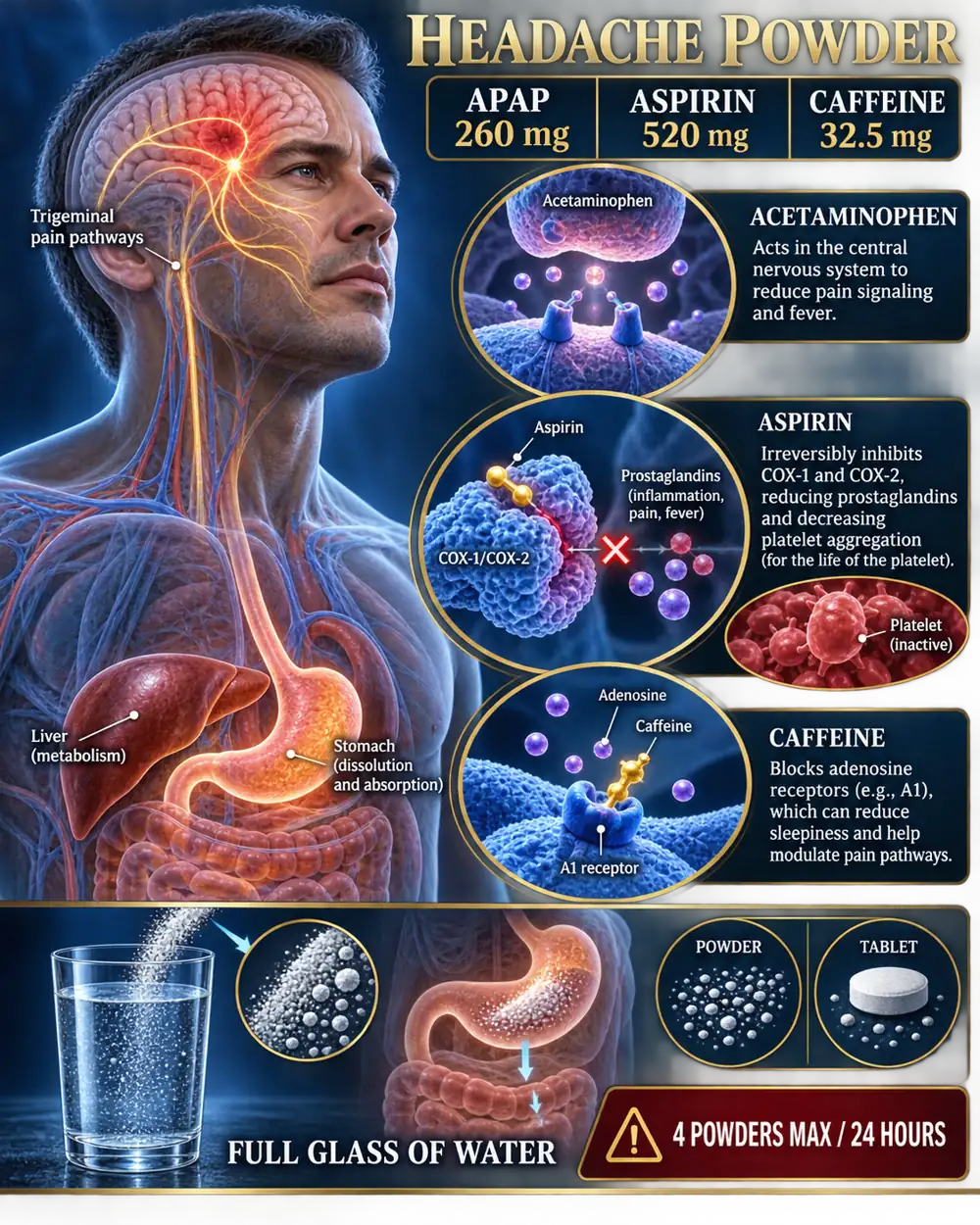
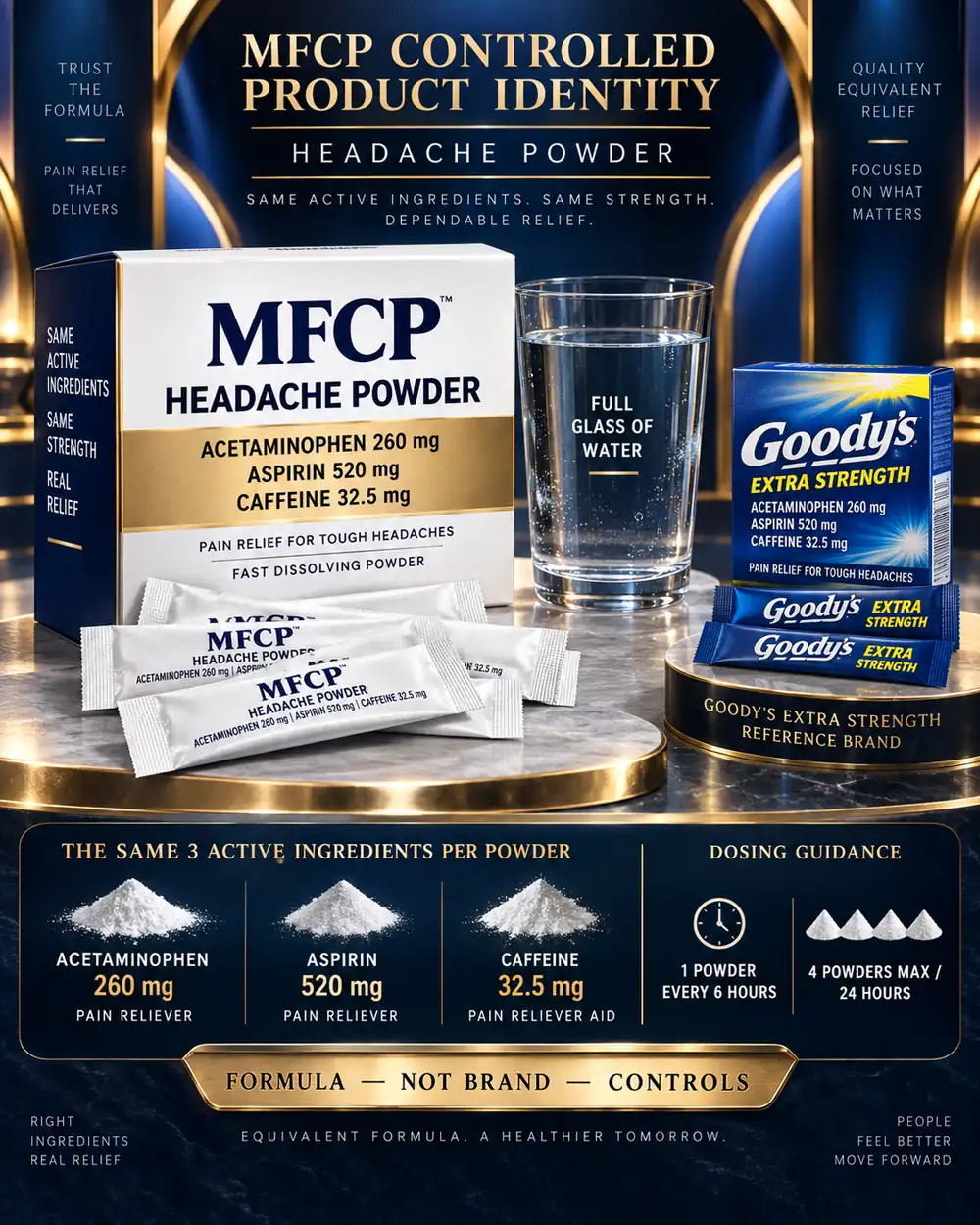
Goody’s Extra Strength combines acetaminophen, aspirin, and caffeine in a loose oral powder. The dosage form changes administration—not the ingredient risks, duplicate-product screen, or Drug Facts ceiling.
One powder, three drugs, four daily—never a fifth.
Acetaminophen 260 mg + aspirin 520 mg + caffeine 32.5 mg per powder.
Place on the tongue and drink a full glass of water, or stir into water or another liquid.
There is no fifth powder unless a doctor directs otherwise.
Count every acetaminophen source and every aspirin/NSAID source separately.
Exact formula, exact form, exact label.
The ingredient ratio—not the brand name—controls the decision.
Dispersion and water are part of correct administration.
APAP liver exposure, aspirin/NSAID harm, and caffeine/overuse patterns.
The front name cannot substitute for the Active ingredients line.
Pain reliever and fever reducer.
NSAID pain reliever and fever reducer.
Pain reliever aid and stimulant exposure.
Listed in Other information; not an analgesic active ingredient.
It still must disperse and dissolve before absorption.
Powder exposes more surface than an intact tablet and can disperse rapidly.
Water helps disperse and swallow the dose and reduces concentrated contact with the stomach.
The label permits mixing the powder into a glass of water or another liquid.
Only aspirin provides meaningful peripheral anti-inflammatory action.
Acts mainly in the central nervous system, with little peripheral anti-inflammatory effect.
Reduces inflammatory signaling and irreversibly inhibits platelet COX-1.
Provides stimulant exposure and can augment analgesic response.
Pain relief ending does not restore platelet function.
Four powders is the 24-hour ceiling.
Children under 12: ask a doctor.
Use while symptoms persist.
Do not compress the interval.
Do not exceed 4 in 24 hours unless directed by a doctor.
Count each ingredient before adding anything else.
| Ingredient | Per powder | Four-powder total | Primary control |
|---|---|---|---|
| Acetaminophen | 260 mg | 1,040 mg | Do not add another acetaminophen product. |
| Aspirin | 520 mg | 2,080 mg | Do not add aspirin or another NSAID; bleeding and renal risk remain. |
| Caffeine | 32.5 mg | 130 mg | Count beverages, energy products, stimulants, and other medicines. |
| Potassium | 60 mg | 240 mg | Consider in patients with potassium restrictions or renal disease. |
The hidden APAP problem and the NSAID problem are not the same.
Cold, flu, sleep, prescription pain, and headache products commonly repeat it.
Bleeding, renal, and allergy risks stack even when brand names differ.
Coffee, tea, cola, energy products, and stimulants all count.
Read the Active ingredients line aloud.
Age 12 does not clear a teenager with flu-like illness.
No self-directed dose is provided.
Children and teenagers who have or are recovering from these illnesses should not receive aspirin.
Confusion, unusual sleepiness, aggression, nausea, or vomiting requires prompt medical evaluation.
Screen before the first packet.
Steroids, other NSAIDs, alcohol, excess dose, and longer use also increase risk.
Faintness, vomiting blood, or persistent stomach pain needs medical attention.
Facial swelling, shock, or asthma symptoms require immediate help.
Stop use and assess total salicylate exposure.
Early liver injury can be silent.
Count aliases as one exposure.
The Drug Facts label makes this a do-not-use condition.
The label identifies severe liver-damage risk.
Contact Poison Control even if the person feels well.
Add every other caffeine source.
Four powders provide 130 mg before beverages or other drugs.
Sleeplessness and occasional rapid heartbeat can occur.
Late exposure can impair sleep and reinforce headache vulnerability.
Frequent caffeine use and abrupt reduction can complicate the pattern.
Combination analgesics with caffeine can sustain medication-overuse headache.
Regular use at this frequency can support a medication-overuse headache diagnosis when other criteria are met.
Headaches become more frequent and the packet is taken earlier.
Frequent or daily use requires clinician-guided headache management—not a larger supply.
The simplest effective ingredient may be safer.
The label especially warns against aspirin in the last 3 months unless a doctor directs it.
Renal reserve, ulcer history, and polypharmacy further narrow the margin.
High blood pressure, cirrhosis, diuretic use, and stomach history require review.
Review all three ingredients and whether a single-ingredient option fits better.
Read the entire medicine list, including powders.
| Exposure | Primary concern | Controlled action |
|---|---|---|
| Warfarin, DOAC, heparin, antiplatelet drug | Bleeding | Do not combine without professional review. |
| Ibuprofen, naproxen, aspirin, other NSAID | Duplicate GI, renal, and allergy risk | Choose one pathway unless directed. |
| Another acetaminophen product | Silent duplicate liver exposure | Do not combine. |
| Steroid or 3+ alcoholic drinks daily | GI bleeding; alcohol also increases liver risk | Ask before use. |
| Methotrexate | Reduced clearance and toxicity | Prescriber review required. |
| Diuretic, ACE inhibitor, ARB, blood-pressure medicine | Renal perfusion or reduced treatment effect | Review kidney function and hydration. |
| Low-dose aspirin for cardiovascular prevention | This powder is not a substitute and adds exposure | Do not swap or add without direction. |
Similar packets can carry different drugs.
This monograph covers only the verified 260/520/32.5 powder.
Do not transfer the Extra Strength caffeine content or directions.
A nighttime name signals a different active-ingredient and impairment screen.
Omit—not invent—any strength not verified on the current label.
The patient determines urgency; the label controls dosing.
Weakness, confusion, seizure, fainting, or speech/vision change.
Fever with stiff neck, head injury, or progressive vomiting.
Headache that wakes the person, worsens lying flat, or follows exertion/cough.
GI bleeding, severe allergy, tinnitus, suspected overdose, or severe skin reaction.
Links already cited on this page.