
Diclofenac sodium 1%, equal to 0.93% diclofenac (Haleon, 2025)
Michael’s Formulary & Clinical Perspective™ (MFCP)America’s OTC Pharmacy™ · Professional Judgment. Delivered.™
MFCP Monograph · Domain 03 · Pain, Fever, Inflammation · Topical Analgesics #1
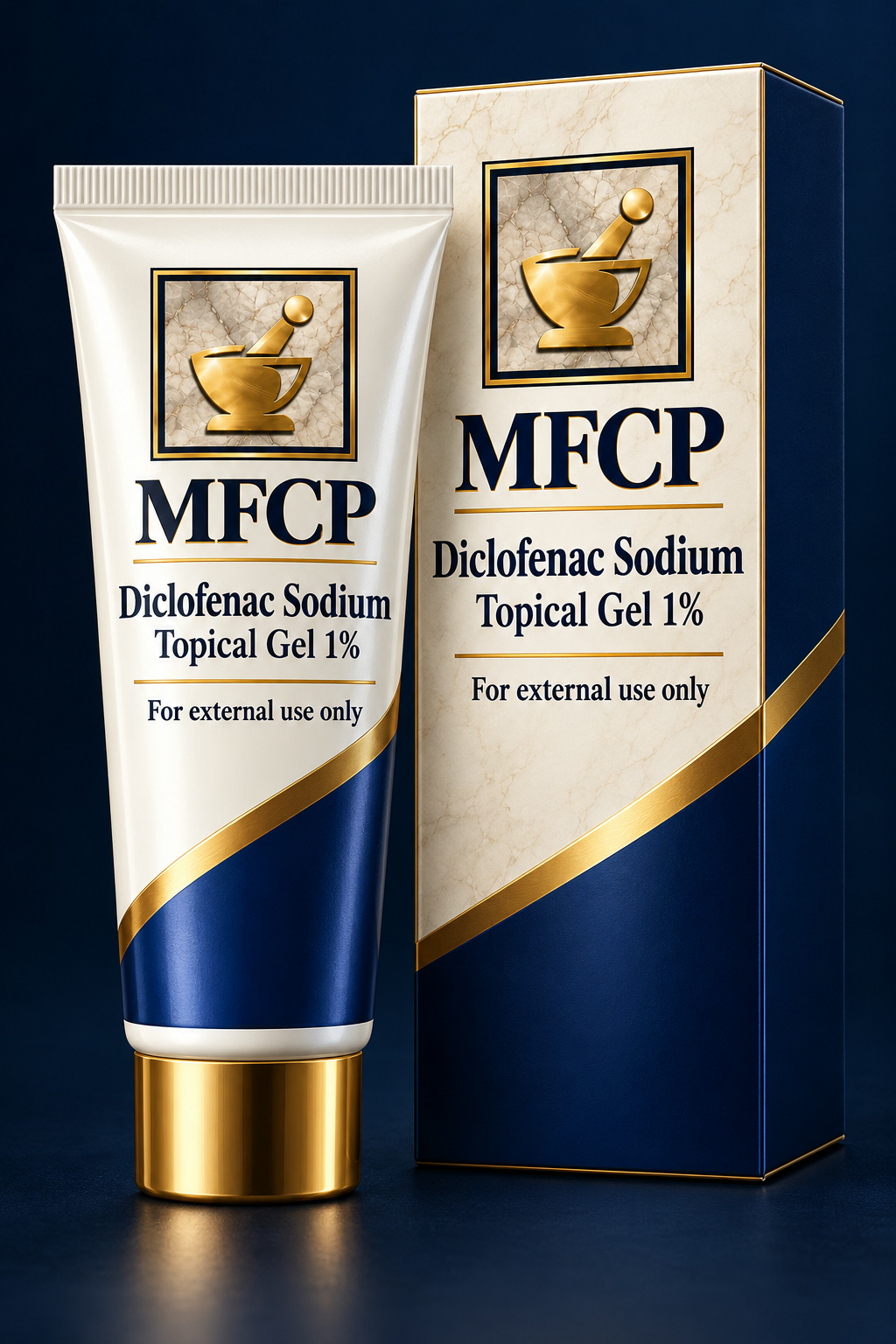
Diclofenac Sodium 1% Gel
Topical NSAID · Voltaren Arthritis Pain · Arthritis pain reliever
A rub-on nonsteroidal anti-inflammatory drug (NSAID) for arthritis pain in the hand, wrist, elbow, foot, ankle and knee (Haleon, 2025). It can take up to 7 days to work; it is not for immediate relief (Haleon, 2025).
Use
Arthritis pain, 6 joints
Form
Gel with dosing card
How often
4 times a day
Limit
21 days; 2 areas
Pharmacist bottom line
A measured, four-times-a-day treatment that builds over a week. It fails on expectations more often than on the drug.
Measure each dose on the card: 2 g for an upper-body joint, 4 g for a lower-body joint, 4 times a day (Haleon, 2025). No more than 2 body areas at once, and no more than 21 days unless a doctor directs it (Haleon, 2025).
ScopeOver-the-counter (OTC) diclofenac sodium 1% topical gel for arthritis pain in six labeled joints. Prescription diclofenac products, patches and solutions are outside this monograph.
MFCP MonographDiclofenac Sodium 1% Gel1 / 9
01
An NSAID that goes on the joint

What it is and how it works
Diclofenac sodium gel is an arthritis pain reliever in the NSAID class (Haleon, 2025). It treats inflammation; it does not numb or cool the skin (MFCP analysis).
Active ingredient
Per gram
10 mg diclofenac sodium (Haleon, 2025)
Class
Arthritis pain reliever; NSAID (Haleon, 2025)
Joints
Hand, wrist, elbow, foot, ankle, knee only (Haleon, 2025)
What it does, and the limits that matter
Build
Up to 7 days
It can take up to 7 days to work (Haleon, 2025).
Measure
The dosing card
2 g upper body, 4 g lower body, 4 times a day (Haleon, 2025).
Limit
21 days; 2 areas
No longer, and no more areas, unless a doctor directs it (Haleon, 2025).
LimitNot for strains, sprains, bruises or sports injuries; the hip, shoulder and back are not labeled joints (Haleon, 2025).
MFCP MonographDiclofenac Sodium 1% Gel2 / 9
02
Read the label in hand
The dosing card and the daily limit
Squeeze the gel onto the card to the line for the joint (Haleon, 2025). Use it 4 times a day, every day (Haleon, 2025).
Joint
Per dose
How often
Per area a day
Hand, wrist, elbow
2.25 inches (2 g)
4 times a day
8 g
Foot, ankle, knee
4.5 inches (4 g)
4 times a day
16 g
Under 18
Ask a doctor
Ask a doctor
Ask a doctor
Voltaren Arthritis Pain label (Haleon, 2025); per-area daily totals calculated (MFCP analysis).
Rules on every label
1
Apply only to clean, dry skin without cuts, wounds, infection or rash (Haleon, 2025).
2
No more than 2 body areas at the same time (Haleon, 2025).
3
No heating pad, and no bandage over the area (Haleon, 2025).
4
Do not apply in the same area as any other product (Haleon, 2025).
MFCP MonographDiclofenac Sodium 1% Gel3 / 9
03
Guideline support, and who should ask first
Evidence and special populations
The 2019 osteoarthritis guideline strongly recommends topical NSAIDs for knee osteoarthritis, and conditionally for hand osteoarthritis (Kolasinski et al., 2020). Under 18, ask a doctor; safety in children is not known (Haleon, 2025).
32 g × 10 mg = 320 mg a day
Grams of gel at the two-knee ceiling, times 10 mg per gram (Haleon, 2025; MFCP analysis). Rubbed on, it is still a real NSAID dose (MFCP analysis).
The label in three numbers
Up to 7
Days to work
21 days
Self-care limit
2
Body areas at once
All three from the label (Haleon, 2025).
Pregnancy
Do not use at 20 weeks or later unless a doctor directs it (Haleon, 2025).
The risk is rare kidney problems in the unborn baby and low amniotic fluid (U.S. Food and Drug Administration, 2020).
Breastfeeding
Topical gel is not expected to harm the breastfed baby (National Library of Medicine, 2025).
Keep the gel off the breast and nipple area (MFCP analysis).
Under 18
Ask a doctor before use (Haleon, 2025).
Safety and benefit in children under 18 are not known (Haleon, 2025).
MFCP MonographDiclofenac Sodium 1% Gel4 / 9
04
Expected effects and the serious ones
Side effects and safety
The label carries allergy, liver, stomach bleeding, and heart attack and stroke warnings (Haleon, 2025). Risk rises with more or longer use than directed (Haleon, 2025).
Allergy
Hives, wheezing, facial swelling, shock, rash or blisters: stop and get help (Haleon, 2025).
Stomach bleeding
Uncommon, but higher at 60 or older, or with ulcers, blood thinners, steroids or other NSAIDs (Haleon, 2025).
Heart and stroke
Heart attack, heart failure and stroke risk rises with more or longer use (Haleon, 2025).
Liver
Liver damage may occur with more or longer use, or with other diclofenac drugs (Haleon, 2025).
!
Where it must not go
Not for strains, sprains, bruises or sports injuries, and not on more than 2 body areas at once (Haleon, 2025). Keep it out of the eyes, nose and mouth; rinse eyes well with water if contact occurs (Haleon, 2025).
Ask a doctor or pharmacist first
1
Is 60 or older, or has had stomach ulcers, bleeding problems or heartburn (Haleon, 2025).
2
Has high blood pressure, heart disease, liver cirrhosis, kidney disease, asthma or a prior stroke (Haleon, 2025).
3
Takes a diuretic (water pill) (Haleon, 2025).
4
Had a bad reaction to any pain reliever or fever reducer (Haleon, 2025).
MFCP MonographDiclofenac Sodium 1% Gel5 / 9
05
Rubbed on, it still interacts
Interactions
Ask a doctor or pharmacist before use if taking any other drug (Haleon, 2025). Other NSAIDs and other diclofenac products add to the risk (Haleon, 2025).
Medicine
What happens
Action
Oral NSAIDs, such as ibuprofen or naproxen
Raise stomach bleeding risk (Haleon, 2025).
Do not combine without a clinician (MFCP analysis).
Other diclofenac products
Raise liver damage risk (Haleon, 2025).
Do not combine (Haleon, 2025; MFCP analysis).
Blood thinners or steroids
Raise stomach bleeding risk (Haleon, 2025).
Ask a doctor first (Haleon, 2025).
Diuretics (water pills)
Named on the label (Haleon, 2025).
Ask a doctor first (Haleon, 2025).
Other creams or rubs on the same joint
The label says not to share the area (Haleon, 2025).
Use one product per area (Haleon, 2025).
Rule
Before recommending the gel, ask about oral pain relievers, other diclofenac products, blood thinners, water pills and every other drug.
LabelAsk a doctor or pharmacist before use if under a doctor’s care for a serious condition (Haleon, 2025).
MFCP MonographDiclofenac Sodium 1% Gel6 / 9
06
Right product, right job
Choose, buy and verify
Four kinds of topical on one shelf. Only one treats inflammation.
Diclofenac gel
Menthol
Lidocaine
Capsaicin
How it acts
Lowers prostaglandins
Cooling sensation
Numbs the skin
Quiets pain nerves with repeat use
Feels like
Nothing at first
Cool, then warm
Numb
Burning at first
Best fit
Arthritis in a labeled joint
Minor muscle ache
Surface pain
Steady use, chronic pain
Diclofenac from its label (Haleon, 2025); the other columns are an MFCP class summary pending their own monographs (MFCP analysis).
!
Two knees is the ceiling
Two lower-body areas at 4 g, 4 times a day, is 32 g of gel (Haleon, 2025; MFCP analysis). That carries 320 mg of diclofenac sodium a day (Haleon, 2025; MFCP analysis).
MFCP Buying Standard™ · check the package in hand
1
Active ingredientDiclofenac sodium 1% (NSAID); purpose: arthritis pain reliever (Haleon, 2025).
2
Dosing cardKeep the reusable card with the tube; it is the dose (Haleon, 2025).
3
Not a cooling rubSay up to 7 days and 4 times a day before the sale (Haleon, 2025; MFCP analysis).
MFCP MonographDiclofenac Sodium 1% Gel7 / 9
07
Clinical red-line gate
When to stop and get care
Joint relief should never delay care for bleeding, a heart or stroke sign, or a severe allergic reaction.
Get care now
1
Feeling faint, vomiting blood, bloody or black stools, or stomach pain that does not get better (Haleon, 2025)
2
Chest pain, trouble breathing, leg swelling, weakness on one side or slurred speech (Haleon, 2025)
3
Hives, wheezing, facial swelling, shock, rash or blisters (Haleon, 2025)
4
Redness or swelling in the painful area, fever, or skin irritation (Haleon, 2025)
5
Gel swallowed: get medical help or contact a Poison Control Center right away (Haleon, 2025)
Stop and ask a doctor
1
No pain relief within 7 days (Haleon, 2025).
2
Pain gets worse or lasts more than 21 days (Haleon, 2025).
3
Any new symptoms appear (Haleon, 2025).
MFCP bottom line
Confirm a labeled joint; screen NSAID allergy, bleeding, heart, kidney and pregnancy; measure on the card, 4 times a day; judge at 7 days; stop at 21.
MFCP MonographDiclofenac Sodium 1% Gel8 / 9