
Clemastine Fumarate
12-Hour Allergy Relief
Longer-acting first-generation H₁ blockade with marked drowsiness and drying effects.

 02
Production Mandate and Bottom Line
Clemastine Fumarate
Monograph at a Glance · allergy relief · 12-hour interval · alertness control
Longer-acting first-generation antihistamine
Clemastine blocks H₁ histamine receptors in the body and brain. It can relieve sneezing, runny nose, itchy or watery eyes, and itching of the nose or throat.
Main tradeoff
Marked drowsiness and strong drying effects can occur. A less-sedating antihistamine is usually a better daytime choice.
The verified 1.34 mg OTC tablet is labeled for one dose every 12 hours. A current prescription syrup is a separate dosage form with its own label and dosing directions.
PATIENT ACTIONCheck the drug name first. Use this medicine only for allergy signs.
 03
Who It Is For
May fit
- Temporary upper-respiratory allergy symptoms
- A person who can avoid driving, alcohol, and other sedating drugs
- A person age 12 or older using the verified 1.34 mg tablet label
Choose another path or ask first
- Routine daytime allergy control
- Age 65 or older
- Glaucoma, urinary difficulty, emphysema, or chronic bronchitis
- Use with sedatives, tranquilizers, alcohol, or another antihistamine
PATIENT ACTIONChoose a less sleepy drug when you must drive, work, or stay alert.
 04
Label & Dosage-Form Control
Clemastine fumarate 1.34 mg tablet
The verified label states that 1.34 mg clemastine fumarate is equivalent to 1 mg clemastine. Match the exact active ingredient and strength before using the dose table.
Current prescription syrup
The current syrup contains clemastine 0.5 mg per 5 mL, present as clemastine fumarate 0.67 mg per 5 mL. Its prescription directions are not interchangeable with the OTC tablet table below.
Read every active ingredient
Confirm the route, strength, age directions, warning panel, seal, lot, and expiration. Historical brand names do not establish present availability or directions.
PATIENT ACTIONMatch the active drug, strength, and dosage form before each dose.
 05
Dose and Administration
| Verified OTC label | Dose | 24-hour maximum |
|---|---|---|
| Adults and children 12 years and older | 1 tablet (1.34 mg) every 12 hours | 2 tablets |
| Children under 12 years | Ask a doctor | Follow clinician direction |
The higher 2.68 mg tablet belongs to separate prescription labeling and cannot be substituted into this OTC dosing table.
PATIENT ACTIONTake one 1.34 mg tablet every 12 hours. Do not take more than two tablets in 24 hours.
 06
What It Treats
- Runny nose
- Sneezing
- Itching of the nose or throat
- Itchy, watery eyes from hay fever or another upper-respiratory allergy
Anaphylaxis, asthma attacks, bacterial infection, or the cause of an allergy.
PATIENT ACTIONUse this drug for runny nose, sneezing, nose itch, or watery eyes.
 07
How It Works
How Clemastine Works
Six controlled steps from an oral dose to relief, sleepiness, and drying effects
Absorption
The tablet is absorbed and reaches peripheral tissues and the central nervous system.
Allergy and wakefulness
Histamine activates H₁ receptors in allergic responses and also supports alertness in the brain.
Symptom relief
Blocking H₁ signaling can reduce sneezing, runny nose, itching, and watery eyes.
Central sedation
Central H₁ blockade can cause marked drowsiness and impair driving or other alert tasks.
Drying burden
Anticholinergic activity contributes to dry mouth, blurred vision, constipation, and urinary difficulty.
Use the tradeoff
Relief must be weighed against sedation, drying, age, other medicines, and the current label.
Histamine signal
Histamine activates H₁ receptors during an allergic response.
Competitive blockade
Clemastine acts as an H₁ antagonist and inverse agonist, reducing histamine-driven symptoms.
Brain and muscarinic effects
It enters the central nervous system and also has antimuscarinic activity. That combination drives sleepiness and drying.
PATIENT ACTIONThis drug blocks an allergy signal. It may also make you sleepy or dry.
 08
Drowsiness and Anticholinergic Burden
Drowsiness may be marked. Dry mouth, blurred vision, constipation, and urinary difficulty can occur. Alcohol, sedatives, and tranquilizers can increase impairment.
PATIENT ACTIONDo not drive until you know how the drug affects you. Avoid alcohol.
 09
Warnings and Ask-First Screen
- Ask a doctor first with glaucoma, emphysema, chronic bronchitis, or trouble urinating from an enlarged prostate.
- Ask a doctor or pharmacist before use with sedatives or tranquilizers.
- Do not exceed the current label dose.
- Keep out of reach of children.
PATIENT ACTIONAsk first if you have eye pressure, lung disease, or trouble passing urine.
 10
Drug and Alcohol Interactions
| Check | Why | Action |
|---|---|---|
| Alcohol | More drowsiness and impairment | Avoid |
| Sedatives or tranquilizers | Additive central nervous system depression | Ask first |
| Another antihistamine or night product | Duplicate dosing and anticholinergic burden | Check every active ingredient |
| Other anticholinergic drugs | More confusion, constipation, blurred vision, or urinary retention | Review with a pharmacist |
PATIENT ACTIONDo not mix this drug with alcohol, sleep drugs, or another allergy drug.
 11
Children and Older Adults
Children
The verified 1.34 mg label directs caregivers to ask a doctor for children under 12. Excitability may occur.
Older adults
Strong anticholinergic effects increase concern for confusion, constipation, urinary retention, and falls. A safer alternative is usually preferred.
PATIENT ACTIONFor a child, follow the exact age rule. Older adults should ask first.
 12
Pregnancy and Breastfeeding
If pregnant or breastfeeding, ask a health professional before use. Do not assume that an old brand package or a different strength has the same directions.
PATIENT ACTIONIf you are pregnant or nursing, ask your health care team before use.
 13
Overdose and Red Flags
Contact Poison Control at 1-800-222-1222 or seek emergency help. Severe sleepiness, agitation, hallucinations, seizures, breathing trouble, abnormal heart rhythm, or loss of consciousness require urgent care.
PATIENT ACTIONFor too much medicine, call Poison Control at 1-800-222-1222 right away.
 14
Brand-Control Record
| Name | Status | MFCP use |
|---|---|---|
| Clemastine fumarate 1.34 mg | Verified OTC label identity; cited NDCs are inactivated | Primary strength and dose control |
| Tavist / Tavist-1 | Historical brand references | Brand-history record only |
| Dayhist / Dailyhist-1 | Historical or legacy references | Do not imply current availability |
PATIENT ACTIONBrand names can change. Trust the active-drug box on the current label.
 15
Buying Standard
- Find clemastine fumarate. Confirm 1.34 mg equals 1 mg clemastine base.
- Check the current status. A historical label does not prove current shelf availability.
- Match the dosage form. Use the tablet directions only for the verified 1.34 mg tablet label.
- Screen for drowsiness and anticholinergic burden.
- Check the seal, lot, and expiration. Omit any package that cannot be verified.
PATIENT ACTIONBuy only a product whose drug, strength, seal, lot, and date you can check.
 16
Use Checklist
PATIENT ACTIONBefore each dose, check the person, drug, strength, amount, and time.
 17
Clinical Comparison
| Medicine | Typical position | Key distinction |
|---|---|---|
| Clemastine | First generation | Longer labeled interval; marked sedation and strong drying |
| Triprolidine or chlorpheniramine | First generation | Shorter labeled intervals; products differ |
| Diphenhydramine | First generation | Strong sedation and anticholinergic burden |
| Loratadine or fexofenadine | Second generation | Usually preferred when alertness matters |
PATIENT ACTIONA newer allergy drug may be a better choice when alertness matters.
18Investigational Remyelination Research
Research signal
The ReBUILD trial found a modest improvement in visual-evoked-potential latency, a physiologic measure used to study remyelination.
Clinical boundary
Clemastine is not FDA-approved to treat multiple sclerosis or to restore myelin. Research findings do not justify self-treatment, and sedation remains clinically important.
Any use for remyelination belongs within specialist-directed research or care.
PATIENT ACTIONDo not use clemastine on your own to treat multiple sclerosis or to restore myelin.
19Evidence and References
Evidence & Source Control
Current labels, FDA guidance, geriatric criteria, and investigational research remain explicitly separated
- DailyMed: Clemastine fumarate 1.34 mg tablet.
- DailyMed: Clemastine fumarate prescription syrup 0.67 mg per 5 mL.
- FDA draft product-specific guidance: Clemastine fumarate 2.68 mg tablet.
- Green et al. ReBUILD randomized crossover trial.
- ClinicalTrials.gov: NCT02040298.
- American Geriatrics Society. 2023 AGS Beers Criteria®.
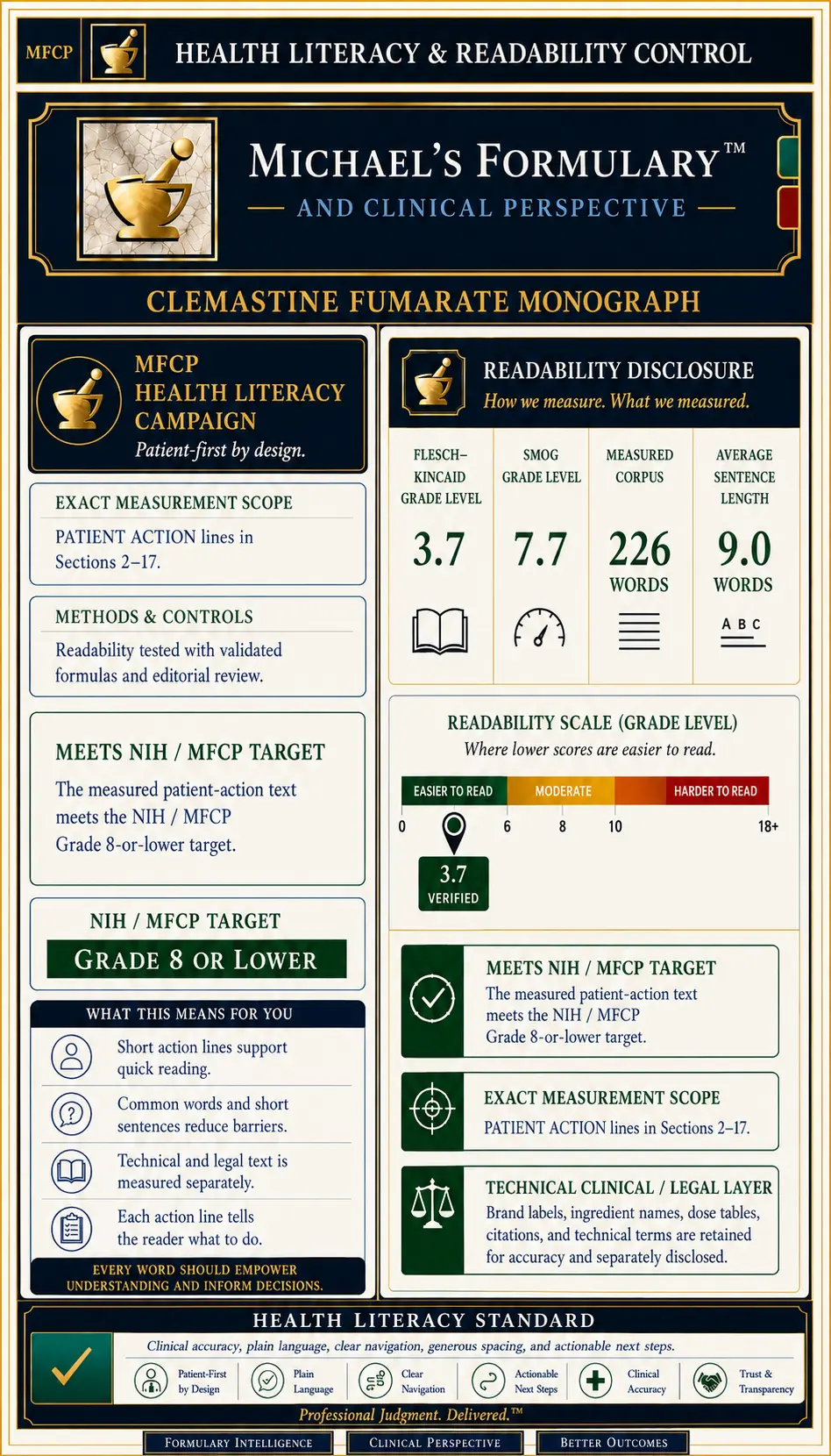
20Health Literacy and Readability