
Occasional, familiar heartburn
Famotidine relieves heartburn associated with acid indigestion and sour stomach. It may also prevent those symptoms after trigger foods or beverages.


Acid reducer · verify strength, form, and current label
Famotidine relieves heartburn associated with acid indigestion and sour stomach. It may also prevent those symptoms after trigger foods or beverages.
The OTC label places preventive dosing 10–60 minutes before the trigger. An antacid may feel faster for symptoms already present.
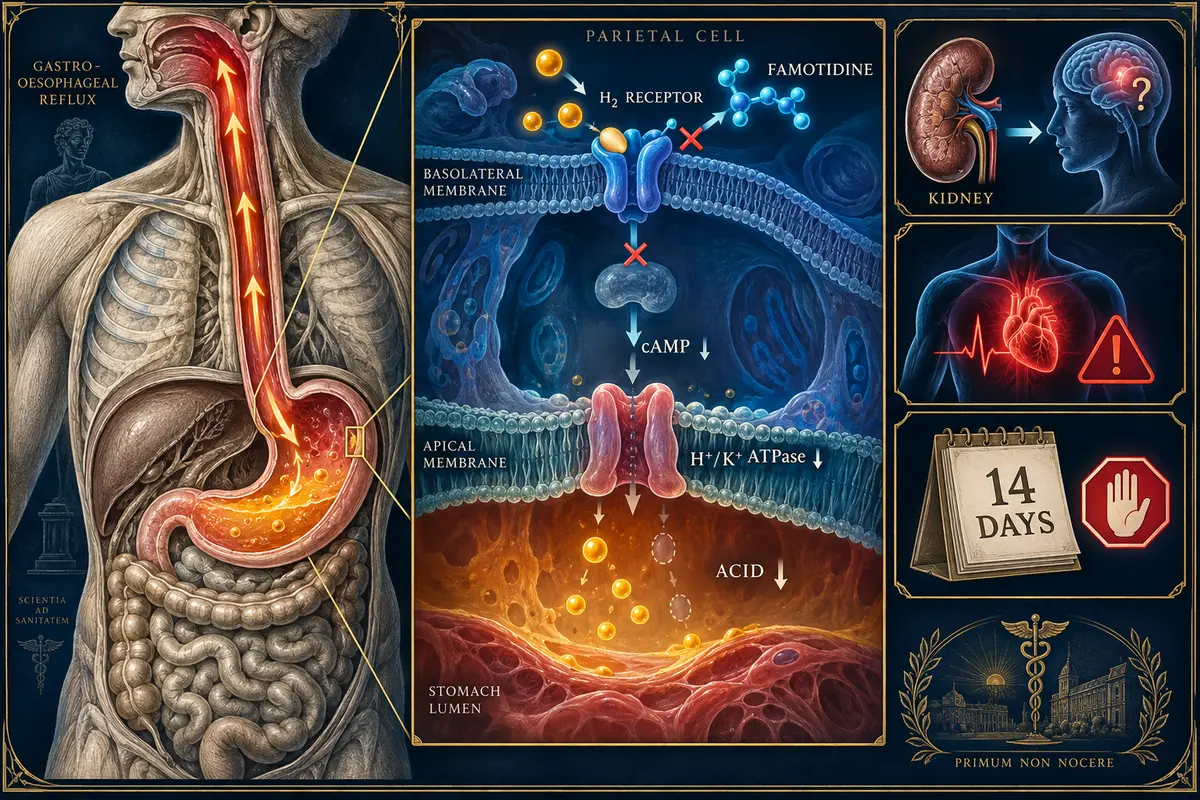
Stop and ask a doctor if heartburn continues, worsens, or the product is needed for more than 14 days.
Chest or shoulder pain, bleeding, trouble swallowing, unexplained weight loss, persistent vomiting, or new prolonged symptoms require evaluation.
Famotidine is an H2 blocker. It is not an H1 allergy antihistamine and is not a proton-pump inhibitor.
Strength affects front-panel wording, but the exact Drug Facts directions still control.
Famotidine 10 mg may be combined with calcium carbonate 800 mg and magnesium hydroxide 165 mg. Do not treat it as a plain famotidine tablet.
| Package type | Identity | What changes | MFCP control |
|---|---|---|---|
| Original strength | Famotidine 10 mg | Lower H2-blocker strength | Follow that exact label |
| Maximum strength | Famotidine 20 mg | Higher H2-blocker strength | Maximum two tablets in 24 hours on the current 20 mg label |
| Dual-action chewable | Famotidine + two antacids | Form, ingredients, directions, interactions | Never transfer plain-tablet directions |
| Prescription tablet | Famotidine 20 mg or 40 mg | Indication and duration are clinician-directed | Do not convert Rx regimens into OTC advice |
Famotidine suppresses gastric secretion at rest, overnight, and after food stimulation. It reduces acid; it does not eliminate every reflux event.
The prescription label reports maximum antisecretory effect in one to three hours and a 10–12 hour duration after 20 mg or 40 mg doses.
| User / purpose | Current 20 mg label direction | Timing | Ceiling |
|---|---|---|---|
| Adults and children 12+ | Swallow one tablet with a glass of water | When symptoms occur | No more than two tablets in 24 hours |
| Prevention | Swallow one tablet with a glass of water | 10–60 minutes before trigger food or drink | No more than two tablets in 24 hours |
| Children under 12 | Not self-selected | — | Ask a doctor |
| Need beyond 14 days | Stop self-treatment | Do not keep extending the course | Ask a doctor |
Brand families can contain different strengths and antacid ingredients.
Take it with a glass of water unless the exact product is labeled as chewable.
Do not add another acid reducer or duplicate famotidine from a second package.
| Presentation | Why it matters | Controlled action |
|---|---|---|
| Chest or shoulder pain with breathlessness, sweating, lightheadedness, or spreading pain | Possible cardiac emergency | Seek emergency evaluation |
| Vomiting blood or coffee-ground material; bloody or black stools | Possible gastrointestinal bleeding | Emergency evaluation |
| Trouble or pain swallowing | Structural disease or significant inflammation | Do not use; prompt clinician evaluation |
| Unexplained weight loss, persistent nausea or vomiting, or stomach pain | Symptoms exceed routine self-care | Ask a doctor before use |
| Heartburn for more than three months, frequent chest pain, or frequent wheezing | Diagnosis and treatment plan require review | Ask a doctor before use |
| Symptoms continue, worsen, or require use beyond 14 days | Persistent disease may be masked | Stop and ask a doctor |
Famotidine is substantially cleared by the kidney. The current OTC label directs people with kidney disease to ask a doctor before use.
Prescription labeling recommends indication-specific maximum-dose or interval adjustments in moderate or severe renal impairment—not one universal “half-dose” rule.
Confusion, delirium, hallucinations, disorientation, agitation, seizures, and lethargy have been reported especially in older adults and renal impairment.
Famotidine may reduce absorption of medicines that require gastric acidity. Prescription-drug users should ask a doctor or pharmacist.
Current prescription labeling describes famotidine as a weak CYP1A2 inhibitor and advises avoiding concomitant tizanidine or monitoring closely if unavoidable.
Cimetidine has a broader CYP interaction profile. Famotidine still requires a real medication review; “cleaner” does not mean interaction-free.
“Famotidine” and either 10 mg or 20 mg are readable on the active-ingredient line.
The indication, 10–60 minute prevention window, 24-hour ceiling, and 14-day limit are legible.
A dual-action chewable declares calcium carbonate and magnesium hydroxide as additional active ingredients.
Famotidine, cimetidine, PPIs, and antacids are not interchangeable by shelf category.
A bulk package does not cancel the label's 14-day evaluation gate.
Reject a broken seal or unreadable label and follow the exact package's storage directions.
Uses, exclusions, alarm symptoms, 10–60 minute timing, two-tablet ceiling, under-12 direction, and 14-day limit.
Mechanism, time course, renal thresholds and dose tables, CNS warnings, pharmacokinetics, and interaction detail.
The OTC label controls self-selection. Prescription regimens are shown only to explain renal and pharmacologic boundaries.
No transferred directions between 10 mg, 20 mg, dual-action chewables, cimetidine, PPIs, or antacids.
Links already cited on this page.