
Separates irritated tissue from contact
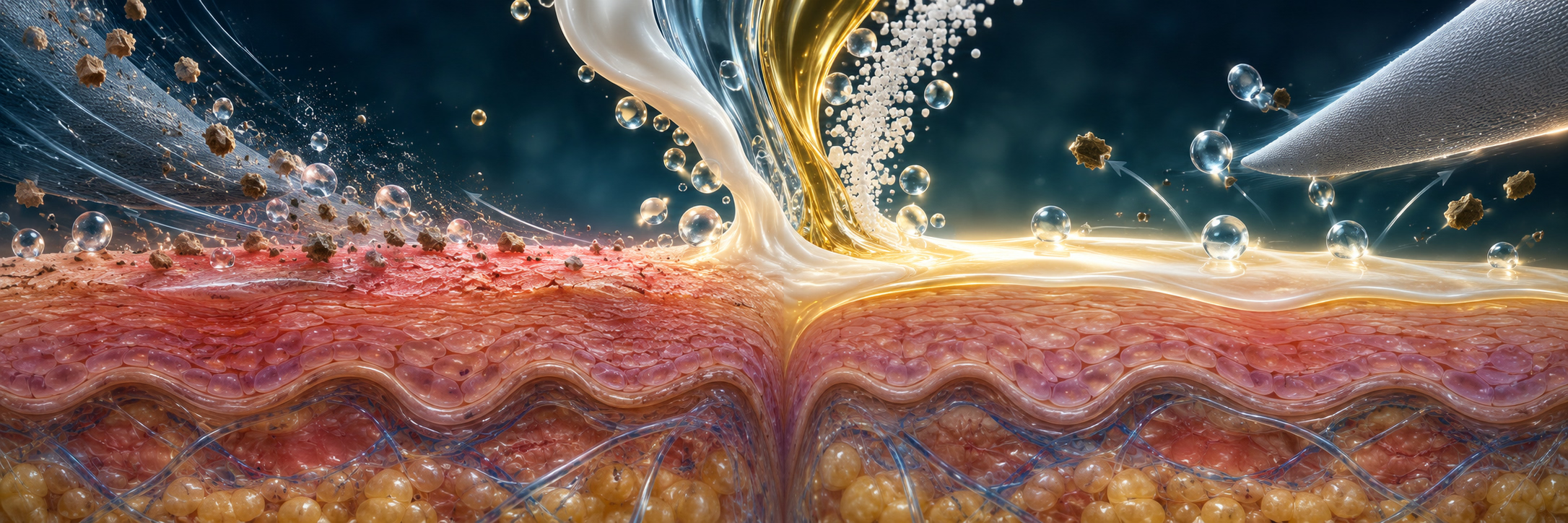
A surface film limits direct exposure to moisture, residue, cleansing products, and friction.

The finished label controls route and frequency
A surface film limits direct exposure to moisture, residue, cleansing products, and friction.
Oily and lipid-rich bases can make passage across the anal verge less abrasive. They do not soften stool already present in the bowel.
Occlusive agents reduce water loss. Adsorbent protectants have a different role when moisture and maceration dominate.
Protectants do not stop active bleeding, remove a thrombus, drain an abscess, reduce prolapse, treat infection, or establish a diagnosis.
A primary anorectal protectant may serve as the only protectant ingredient when it makes up at least 50% of the finished product, subject to ingredient-specific conditions.
Each anorectal protectant generally contributes at least 12.5% of the finished product, with specific exceptions for cod liver oil and shark liver oil.
Calamine, cod liver oil, shark liver oil, and zinc oxide may be used only with one to three other anorectal protectants and within their special limits.
| Ingredient rule | Exact requirement | Why it matters |
|---|---|---|
| Glycerin | 20%–45% aqueous solution; final product contains 10%–45% glycerin | Every combination containing glycerin must meet the minimum glycerin amount |
| Calamine + zinc oxide | Total zinc oxide cannot exceed 25% per dosage unit | Counts zinc oxide contributed by both ingredients |
| Cod liver oil / shark liver oil | Daily labeled amount must supply specified vitamin A and cholecalciferol quantities | There is no universal 3% ceiling for shark liver oil |
| Aluminum hydroxide gel / kaolin | Cannot be combined with cocoa butter, hard fat, lanolin, mineral oil, petrolatum, white petrolatum, cod liver oil, or shark liver oil | This is not a mix-at-home category |
| Anorectal protectant | Ingredient group | Physical role | Route discipline |
|---|---|---|---|
| Petrolatum / white petrolatum | Primary hydrocarbon protectant | Highly occlusive barrier; reduces water loss and contact | External or intrarectal only when the finished label permits |
| Mineral oil | Primary liquid-hydrocarbon protectant | Improves spread and surface lubrication | Follow the finished label |
| Cocoa butter | Primary solid-lipid protectant | Body-temperature-softening lipid used in ointment or suppository systems | Follow the finished label |
| Hard fat | Primary solid-lipid protectant | Structured triglyceride base used in solid rectal dosage forms | Follow the finished label |
| Lanolin | Primary emollient protectant | Water-binding lipid component | Follow the finished label; sensitization is possible |
| Aluminum hydroxide gel / kaolin | Moist-condition protectants | Adherent protectants for moist anorectal conditions | Greasy ointment can interfere with adherence; use exactly as labeled |
| Topical starch | Primary absorbent protectant | Absorbs surface moisture | Not categorically external-only; the finished label controls |
| Glycerin | External humectant protectant | Attracts and retains water at the treated surface | External-use-only claims and directions |
| Calamine / zinc oxide | Combination-only mineral protectants | Protectant and astringent roles in moisture-prone settings | External and/or intrarectal only as the finished label permits; total zinc oxide ≤25% |
| Cod liver oil / shark liver oil | Combination-only lipid protectants | Emollient lipid components | Special daily vitamin A/D labeling; follow the finished product |
Petrolatum, mineral oil, cocoa butter, hard fat, and related emollients create continuity across the surface.
Kaolin, topical starch, zinc oxide, or calamine may support a drier surface when the approved formula and label permit.
Multiple agents can balance glide, staying power, water control, and dosage-form stability.
Format: ointment. Clinical role: durable coating, spread, and surface lubrication. A vasoconstrictor or anesthetic may add separate activity and stricter controls.
Format: wrapped suppository. Clinical role: melts or softens after labeled rectal insertion and distributes the active formulation locally.
Format: thick ointment or paste. Clinical role: combines surface occlusion with mineral protectant/astringent activity.
These ingredients have a distinct moist-condition role. Petrolatum or greasy residue can interfere with adherence and should be removed when the label instructs.
The FDA anorectal drug standard gives glycerin a special aqueous concentration rule and external-use-only labeling framework.
Choose the finished dosage form for the actual problem: dry friction, moisture and maceration, external tenderness, or a specifically labeled intrarectal indication.
| Combination pattern | Added action | MFCP interpretation |
|---|---|---|
| Protectant + vasoconstrictor | Physical coating plus temporary reduction in hemorrhoidal swelling | Phenylephrine adds cardiovascular, drug-interaction, frequency, and patient-screening controls |
| Protectant + local anesthetic | Physical barrier plus temporary nerve-conduction blockade | Pramoxine or another permitted local anesthetic relieves symptoms but can mask a worsening lesion |
| Protectant + astringent | Barrier plus temporary protection and relief of irritation/burning | Calamine or zinc oxide also counts toward the 25% total-zinc limit |
| Three-class or larger combination | Multiple symptom pathways | More actives do not mean broader self-treatment permission; the strictest warning and dosing limit governs |
When practical, cleanse and rinse thoroughly, or pat/blot with an appropriate cleansing pad.
Gently dry with toilet tissue or a soft cloth. Avoid scrubbing already irritated tissue.
Apply to the affected external area at the labeled frequency. Never insert an external-only product with fingers or a device.
The FDA anorectal drug standard directs removal of the wrapper before rectal insertion. Follow the specific product for all additional technique instructions.
Attach the supplied applicator, lubricate it well, and insert gently. Stop and consult promptly if insertion causes additional pain.
The FDA anorectal drug standard directs professional advice rather than unsupervised self-treatment for children younger than 12.
| Product pattern | Anorectal frequency framework | Control point |
|---|---|---|
| Many listed protectants; calamine or zinc oxide | Up to 6 times daily or after each bowel movement | The finished label may be more restrictive |
| Petrolatum or white petrolatum | Apply liberally as often as necessary | Only when those directions appear on the finished product |
| Combination with phenylephrine | Up to 4 times daily | The stricter vasoconstrictor limit controls |
| Combination product generally | Cannot exceed the lowest applicable maximum | Check every active ingredient and direction |
| Finding or situation | Why it matters | Controlled action |
|---|---|---|
| Any anorectal bleeding | The source cannot be assumed to be hemorrhoids | Consult a doctor promptly |
| Condition worsens or does not improve within 7 days | The diagnosis or treatment may be wrong | Stop self-care and obtain clinical advice |
| Applicator causes additional pain | Insertion may be aggravating a lesion | Stop applicator use and consult promptly |
| External-only label | The product is not authorized for insertion | Do not insert with fingers, a device, or an applicator |
| Severe throbbing pain, fever, drainage, or spreading redness | Possible abscess or infection | Urgent clinical evaluation |
| New intensely painful lump or irreducible prolapse | Possible thrombosis or incarcerated prolapse | Prompt or urgent assessment |
| Dark/tarry stool, weakness, faintness, or shortness of breath | Possible significant gastrointestinal bleeding | Urgent or emergency evaluation |
| Repeated need for treatment, bowel-pattern change, or unexplained weight loss | Requires diagnosis rather than repeated symptom masking | Arrange formal evaluation |
Defines protectant ingredients, permitted combinations, formula limits, claims, warnings, route language, and directions.
Demonstrates how protectants function inside a multi-class ointment and how the stricter vasoconstrictor frequency applies.
Demonstrates a lipid suppository matrix with a combination-only mineral protectant.
Links already cited on this page.